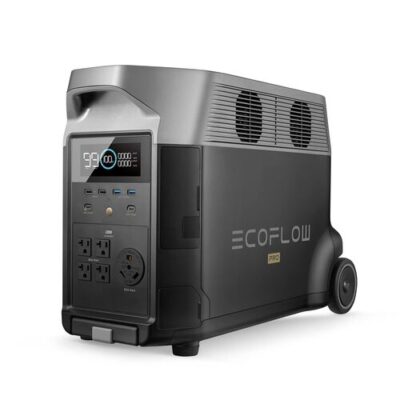
EcoFlow DELTA Pro 3 Review: Big 240V Backup Power Without the Generator Noise
At a Glance
KEY FEATURES
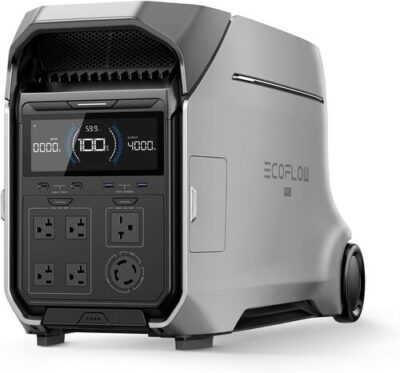
- EcoFlow DELTA Pro 3: large portable power station / solar generator for home backup, RVs, emergencies, and heavier 120V/240V loads
- Battery: 4096Wh, LiFePO4 / LFP, rated around 4000 cycles to 80% capacity
- AC output: 4000W continuous, 6000W starting / X-Boost claim; pure sine wave not specified in the supplied product data
- Ports: exact AC / USB port count not fully specified in the supplied listing; reviews mention 120V/240V output, 30A outlets, RV-style use, and multiple plug options
- Recharge: AC up to about 1800W; solar up to 2600W from dual inputs; car charging not specified in supplied data
- Smart features: EcoFlow app, Wi-Fi / Bluetooth-style app control, remote monitoring, firmware updates, 10 ms UPS-style switchover claim, neutral-ground bonding control mentioned by owners
- Build: 115 lb, 16.16" L x 13.43" W x 27.38" H, black finish, wheels and telescoping handle
- Best for: home outages, refrigerator backup, furnace backup, RV power, well pumps, generator pairing, hurricane prep, and semi-stationary off-grid setups
PROS
- 4,096Wh LFP and native 4,000W 120V/240V output.
- Dual solar inputs support up to 2,600W combined when separately designed.
- 10ms-class UPS specification and broad integration ecosystem.
- Expansion supports longer-duration backup.
CONS
- About 113.5 lb before batteries or integration hardware.
- Home and 240V use require circuit, grounding, and transfer planning.
- Two solar inputs require independent electrical designs.
- Complete system cost can extend far beyond the base unit.
Editor's Choice
Based on exact documentation and qualitative exact-ASIN owner evidence; no hands-on test or population-rate claim
⚡ Can the EcoFlow DELTA Pro 3 Run It?
Choose a common device and see the estimated runtime, whether the inverter can handle it, and how long the power station may take to recharge.
Picture this: the power drops, the fridge is full, your router is dead, and the gas generator is sitting outside in the rain. For a lot of buyers, that’s exactly the problem this unit is trying to solve.
The DELTA Pro 3 isn’t a tiny camping battery, and honestly, it barely feels “portable” in the normal sense. From what owners report, it makes the most sense as a quiet, rolling home-backup battery for fridges, furnaces, RVs, well pumps, short outages, and generator-paired emergency setups.
The DELTA Pro 3 is not merely a larger DELTA Pro. Its native 120/240V output, 4,096Wh battery, 4,000W continuous rating, 8,000W surge, dual solar architecture, quieter low-load target, and faster UPS specification change how one unit can be deployed. It can address selected wells, RV equipment, workshop loads, and home circuits without the paired-unit assumptions of the original generation.
Owner evidence clusters around mobility, high-load and UPS use, runtime, solar, support, app behavior, noise, and shipping. Successful installations demonstrate plausible use; critical reports identify commissioning and service risks. Neither side establishes a population rate. A system this large deserves a versioned record of firmware, settings, loads, cables, source behavior, and test results.
| Architecture layer | DELTA Pro 3 role | Required proof |
|---|---|---|
| Loads | Selected 120V and 240V circuits up to total output limits | Voltage, startup, continuous watts, daily watt-hours |
| Transfer | Direct outlets, compatible hub/panel, or listed connection | Isolation, neutral/ground, overcurrent, permits, restoration |
| Recovery | AC, generator, high-voltage solar, low-voltage solar | Source quality and limits tested independently |
| Storage | 4,096Wh base with expansion path | Reserve, cable protection, space, charge time |
The two solar lanes must be designed separately. EcoFlow documents a high-voltage input up to 1,600W and a low-voltage input up to 1,000W, each with its own voltage and current window. Do not add their limits and then attach one undivided array. Calculate cold Voc, operating current, connector, polarity, cable loss, and shade behavior for each MPPT.
Four kilowatts of output does not equal four kilowatt-hours of long runtime. A continuous 3kW load can deplete the base battery quickly after conversion and reserve, while a cycling refrigerator, well pump, network, and lights may fit a much longer schedule. Expansion should follow measured daily energy rather than anxiety about nameplate loads.
Any connection to home wiring requires compatible listed equipment and qualified work where applicable. Never backfeed through an improvised cord. Record transfer isolation, grounding, breaker protection, circuit selection, and local requirements. The 10ms UPS specification should still be tested with the exact protected equipment through multiple loss and restoration cycles.
Evidence-led verdict: DELTA Pro 3 is strongest when native split-phase output, dual solar recovery, and one-unit mobility solve a measured backup topology. It is excessive for simple 120V electronics and incomplete for a home until transfer, circuits, sources, and duration are designed.
DELTA Pro 3: Native 120/240V Changes the Backup Topology
Pro Tip — Use a gas generator for fast daytime recharging, then run quietly from the battery overnight. This pairing reduces generator noise and fuel use significantly.
A 113.5-Pound Wheeled Station Needs a Deployment Route
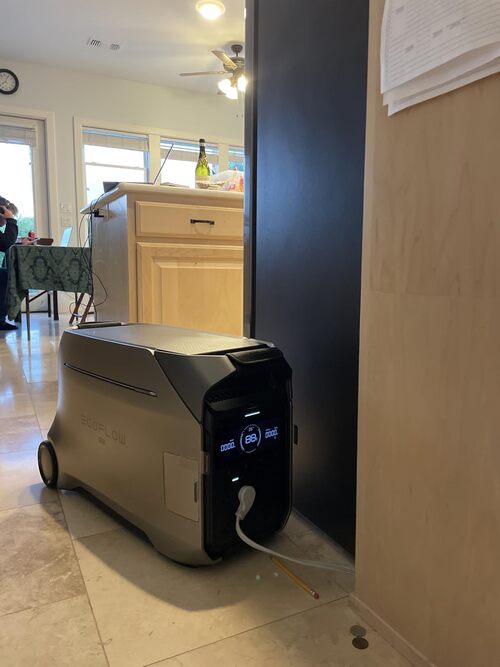
The EcoFlow DELTA Pro 3 portable power station looks more like a premium appliance than a jobsite generator. Owners often describe the finish as clean and modern, with a low, tidy shape that doesn’t look strange in an office, basement, RV, or garage corner.
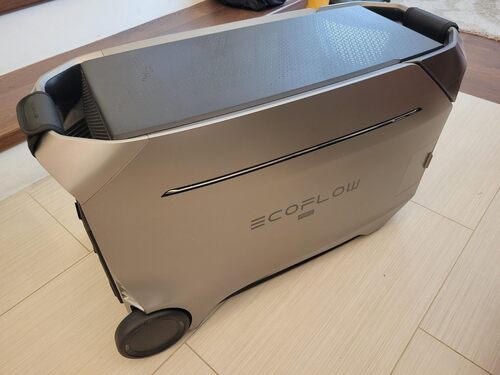
That said, the “portable” part needs context. At 115 lb, this thing has a solid heft that feels reassuring until you need to lift it into a vehicle or carry it up stairs. The wheels and telescoping handle help on smooth floors, driveways, and garage slabs, but gravel, hills, and staircases quickly turn it into a two-person job.
In practice, it works best when you treat it like a movable home battery, not a grab-and-go camping pack. Several owners like storing it in a corner near a transfer setup or extension-cord path, then rolling it out when needed.
Buyer Heads-Up — If you plan to move this in and out of a truck often, measure your route first. Door thresholds, stairs, gravel, and basement steps matter more than the spec sheet suggests.
Schedule 4,096Wh Before Expanding Toward 12kWh
The headline number is 4096Wh. In plain English, that means the EcoFlow 4096Wh LiFePO4 power station has enough stored energy to run a refrigerator for many hours, keep internet gear alive for days, or cover a mix of lights, furnace controls, router, TV, and small appliances during a shorter outage.
Here’s the thing: 4kWh sounds huge until you plug in heating appliances. A refrigerator, gas furnace blower, modem, router, and lights are a good match. Electric heat, dryers, stoves, and large air conditioning loads are a different story.
| Device | Typical Power Draw | Estimated Runtime | Realistic with Margin |
|---|---|---|---|
| Smartphone charging | 10–15Wh per charge | 270–400 charges | About 230–340 charges |
| Laptop | 50–80Wh per charge | 43–69 charges | About 36–58 charges |
| Wi-Fi router | 10–20W | 155–310 hours | About 130–260 hours |
| CPAP machine, no humidifier | 30–60W | 52–104 hours | About 44–88 hours |
| Mini fridge | 40–80W cycling | 39–77 hours | About 33–65 hours |
| Full-size refrigerator | 100–200W cycling + surge | 15–31 hours | About 13–26 hours |
| Gas furnace blower / controls | 300–700W cycling | 4–10 hours while running | Depends heavily on cycling |
| 5k BTU window AC | 500–700W running | 4–6 hours | About 3–5 hours |
| 1500W kettle | 1500W | About 2 hours total heating time | Brief use only |
Real-World Math — At 0.84 AC efficiency, the listed 4096Wh battery delivers roughly 3440Wh through the AC outlets. Subtract a 10% reserve, and you’re working with about 3096Wh of practical AC energy.
In real use, customers often get the best results by choosing their loads carefully. Run the fridge, freezer, router, lights, and furnace controls, but don’t treat the battery like a gas generator that can casually feed every heavy circuit all day.
Four Kilowatts Across 120V and 240V Loads
At the same time, output is not just about watts. Transfer-switch wiring, neutral-ground bonding, 120V versus 240V mode, surge behavior, and which outlets can run together all matter. Some buyers had smooth results; others ran into tripped protection, GFCI issues, or confusing limitations.
| Device | Typical Draw | This Unit? |
|---|---|---|
| Phone / tablet | 10–25W | Easy |
| Laptop | 50–100W | Easy |
| LED lights | 5–15W each | Easy |
| Wi-Fi router | 10–20W | Easy |
| CPAP, no humidifier | 30–60W | Easy |
| Full-size refrigerator | 100–200W cycling, higher surge | Easy |
| Freezer | 80–200W cycling | Easy |
| Gas furnace blower | 300–700W cycling | Easy |
| Microwave, 700W cooking class | Around 1100W draw | Easy |
| Coffee maker | 800–1500W | Easy, but drains fast |
| 5k BTU window AC | 500–700W running, higher surge | Solid fit |
| 240V well pump | Varies widely | With caveats |
Worth Knowing — Continuous output is the real ceiling. The 6000W starting claim is for short surge moments, not for running several large heating appliances at once.
Owners using this as a home-backup unit tend to be happiest when they build a priority-load plan. In practice, fridge plus furnace plus router plus lights is a much better use case than trying to power a whole house exactly as if the grid were still on.
Two Solar Lanes and Multiple Recovery Sources
Charging is one of the DELTA Pro 3’s biggest strengths. AC wall charging is reported up to about 1800W, and owners like using a gas generator for a few hours during the day to recharge the battery, then running quietly from stored power overnight. Safe indoor operation between recharge cycles is explained in our using backup batteries indoors guide.
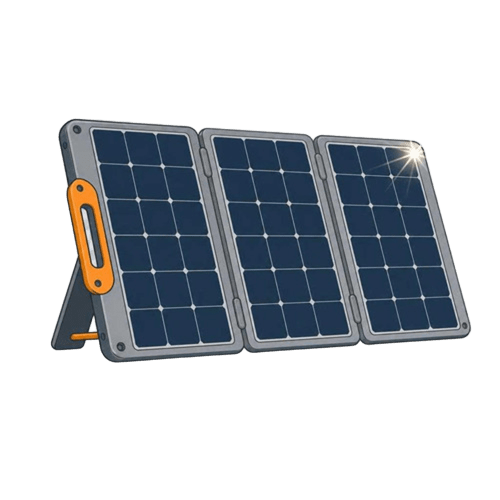
Solar is also a major selling point. The unit can accept up to 2600W across two solar inputs, which is much higher than many smaller portable power stations. The catch is that solar gets technical fast: panel voltage, series wiring, parallel groups, cold-weather voltage rise, and connector choices all matter.
| Charging Mode | Time From Empty to Full | Noise Level |
|---|---|---|
| Quiet / low AC setting | About 5–8 hours, depending on limit | Quiet hum |
| Standard AC | About 3–4 hours | Moderate fan sound |
| Fast AC, up to 1800W | About 3 hours | More noticeable fan sound |
| Generator at AC input | About 3 hours if the generator supports the load | Generator noise outside |
| 2600W solar full setup | About 2 hours strong sun | Silent |
Grid and Generator Recovery — DELTA Pro 3
AC charging from a wall outlet or generator is fast and practical for outage situations. The high input wattage means you can get back to full capacity quickly when power becomes available.
Dual-MPPT Recovery — DELTA Pro 3
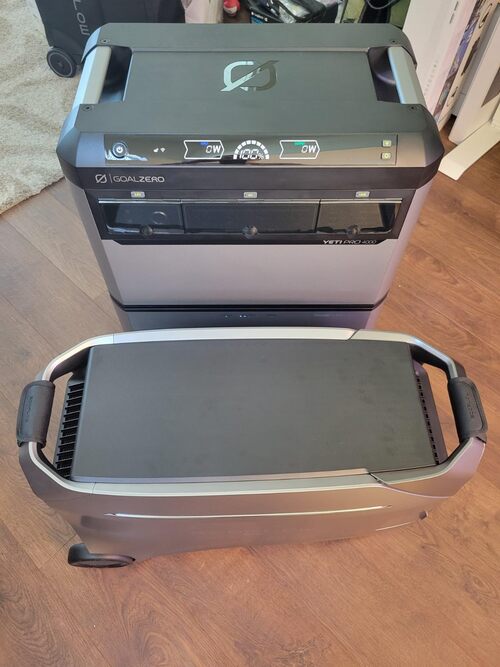
Adapter Check — If you already own third-party solar panels, check voltage ranges and connector needs before buying cables. Several owners found solar setup less obvious than the marketing makes it sound.
For off-grid use, the high solar ceiling matters most when you have enough panels to take advantage of it. A single small portable panel will work more like a slow trickle. A serious solar array can turn the DELTA Pro 3 solar generator into a much more capable multi-day backup system.
L14-30, TT-30, and the Home-Integration Boundary
Customer feedback points to 120V and 240V AC output, 30A outlet use, RV-style plug use, front and side output areas, solar inputs, expansion connections, and app-controlled settings.
On the flip side, owners mention missing or extra-cost accessories. The lack of a built-in 12V cigarette-style socket comes up, as does the need for dongles or adapters for some EcoFlow accessories, RV setups, EV charging setups, and older DELTA Pro accessories.
In practice, the port selection is powerful but not always simple. If your setup depends on a specific 30A plug, transfer switch, EV adapter, or smart generator cable, confirm the exact adapter chain first.
Lower-Load Quietness Still Needs Ventilation
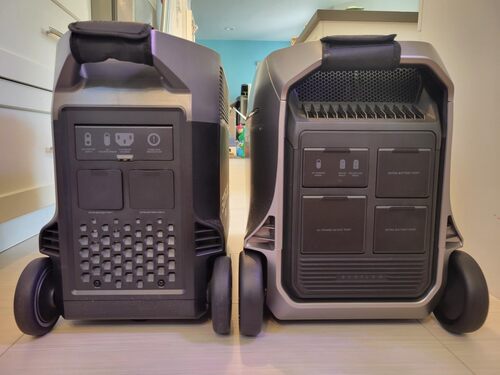
Customer feedback generally suggests the DELTA Pro 3 is quiet under lighter loads. Owners describe a low hum rather than a harsh generator sound, and that makes it useful for basements, offices, RVs, condos, and nighttime outage backup.
That said, fans can ramp up during fast charging, high-watt output, EV charging, or hot-garage use. One owner noted the unit needed a cool-down period after a heavy discharge in a warm garage before it would recharge again.
Worth knowing, quiet does not mean invisible. You’ll still want airflow around it, and you probably won’t want it tucked into a sealed closet while pushing heavy loads.
Automation Requires a Manual Recovery Drill
The display and app are a mixed story. Happy owners like seeing live input, output, battery percentage, charge settings, and firmware options. The app also gets praise for deeper controls, including neutral-ground bonding settings that matter for RVs and some EV charging setups.
The catch is app dependence. Some buyers complain about login timeouts, geo-locking, pairing trouble, firmware update failures, internet requirements, and not being able to change settings when they need control most.
For beginners, basic use can feel simple: charge it, turn on the output, plug in your devices. However, for home backup, RV wiring, solar arrays, or transfer-switch use, you’ll want to learn the app before the first real outage.
Expansion Turns Settings Into System Records
The DELTA Pro 3 uses LiFePO4 battery chemistry. That’s a good fit for backup power because LFP is generally preferred for cycle life, thermal stability, and frequent use. The trade-off is weight, and this unit definitely pays that price.
Owners also like the 5-year warranty, but support feedback is uneven. Some buyers received help quickly or had parts replaced under warranty. Others describe slow replies, missed calls, return headaches, replacement concerns, or frustrating troubleshooting loops.
Long-Term Ownership — Around 4000 cycles to 80% capacity means years of regular cycling before major battery wear should show up. Daily off-grid users and RV owners should still avoid storing it empty or full for long stretches.
Safety deserves a plain warning here. Most owners report normal operation, but negative experiences include electrical smell, overheating, error codes, battery failures, charging failures, and even damaged connected devices in one home-backup test.
Best Practice — Store the battery around 50–80% when you won’t use it for a while, and top it off every few months. LiFePO4 is durable, but leaving any lithium battery at 0% for a long time is asking for trouble.
The manual-related comments also matter for weather and temperature. Despite IP65 language around the battery pack, buyers should avoid treating this like an outdoor gas generator that can sit in rain without thought.
DELTA Pro 3 Deployment Architecture
| Use Case | Fit | Why |
|---|---|---|
| Weekend car camping | Borderline | Tons of power, but 115 lb is overkill for casual camping |
| RV side-trip / van life | Strong fit | 30A-style use, quiet output, big battery, and 120V/240V flexibility help |
| Home blackouts under 8 hours | Strong fit | Excellent for fridge, router, lights, furnace, and selected circuits |
| Multi-day off-grid cabin | Solid fit | Strong if paired with enough solar or generator charging |
| CPAP overnight backup | Strong fit | Far more capacity than a CPAP needs for one night |
| Refrigerator backup | Strong fit | A common real-world use, with good surge headroom |
| Jobsite power tools | Solid fit | Handles many tools, but heavy transport and surge stacking need care |
| Quiet bedroom UPS | With caveats | Quiet and fast switchover claim, but app and pass-through complaints matter |
| Hurricane / multi-day outage | Strong fit | Works well when paired with solar, generator charging, or extra batteries |
| Tailgating / outdoor events | Borderline | Powerful and quiet, but very heavy for casual hauling |
| Backpacking / lightweight EDC | Skip | Completely wrong weight class |
| Apartment without solar access | Solid fit | Quiet indoor backup is useful, but recharging depends on available AC power |
You’ll probably be happy if you want:
- A large LiFePO4 battery for fridge, furnace, router, and light backup
- Quiet overnight power after recharging from a generator during the day
- 120V/240V flexibility for RVs, pumps, or selected home circuits
- High solar input for a serious off-grid panel setup
- App-level control over charging, monitoring, and advanced settings
You might want to skip it if you need:
- A power station you can easily lift into a car by yourself
- App-free operation in remote places with unreliable internet
- Simple beginner solar setup with no voltage math
- A flawless dedicated UPS replacement for sensitive transfer-switch setups
- Budget backup power for only phones, laptops, and a router
Pros & Cons Analysis
Based on documented specifications and owner feedback
Pros
- Native split phase changes the use case — One station can support selected 120V and 240V loads without pairing two inverter units.
- Base storage is substantial — 4.096kWh can cover a measured essential-load schedule before expansion is necessary.
- Solar recovery is well matched — Separate high- and low-voltage inputs allow considerable valid array capacity and different orientations.
- Modern continuity features are useful — A faster UPS specification, app controls, and quieter low-load target suit integrated backup after testing.
- Ecosystem growth is broad — Expansion batteries and compatible transfer hardware can move the unit from direct backup toward a larger system.
Cons
- It is movable infrastructure — Weight, thresholds, stairs, floor placement, ventilation, restraint, and cable routes need advance planning.
- Split phase invites overreach — A 240V receptacle does not guarantee enough current or energy for every dryer, HVAC system, range, or EV charger.
- Home integration is site-specific — Transfer isolation, neutral-ground behavior, protection, permits, and qualified work cannot be generalized.
- Solar mistakes can be costly — Each MPPT needs its own cold-voltage, current, connector, and polarity calculation.
- Software and restoration are operational risks — Firmware, reserve, automation, output persistence, and recovery should be documented and drilled.
Our Verdict
For this EcoFlow DELTA Pro 3 review, the main takeaway is pretty clear: this is a powerful, quiet, semi-stationary home-backup battery that can solve real outage problems when you understand its limits. It's especially good for refrigerators, furnaces, internet gear, RVs, pumps, generator pairing, and setups where 240V support matters.
That said, it is not a casual portable power station. The weight is serious, the app complaints are real, and transfer-switch or 240V users should do their homework before buying. Choose it if you want a heavy-duty EcoFlow DELTA Pro 3 battery backup for outages and RV use; skip it if you need lightweight camping power or a simple plug-and-forget UPS with no setup learning curve.
Frequently Asked Questions
Can the EcoFlow DELTA Pro 3 run a full-size refrigerator?
Yes. Customers frequently use it for full-size refrigerators and freezers during outages. Runtime depends on compressor cycling, room temperature, and what else is plugged in, but owners commonly describe fridge backup as one of its strongest uses.
Can the EcoFlow DELTA Pro 3 power a whole house?
It can power selected home circuits through the right transfer setup, but it is not unlimited whole-home power. Buyers report success with fridges, lights, routers, furnaces, water heaters, and well pumps, while high-draw appliances like dryers, stoves, and large HVAC loads can drain the battery quickly.
Does the EcoFlow DELTA Pro 3 support 240V output?
Yes. A major reason customers choose it is 120V/240V output from one unit. That said, some owners report caveats with continuous 240V use, transfer-switch wiring, and simultaneous outlet use, so it is worth checking your exact setup before buying.
How long does the EcoFlow DELTA Pro 3 take to recharge from AC?
Owners commonly describe fast AC charging as one of the best features. The supplied review data points to about 1800W AC input and roughly 3 hours to full in fast charging, with some users reporting around 2 to 2.5 hours depending on outlet and settings.
How much solar can the EcoFlow DELTA Pro 3 accept?
The DELTA Pro 3 supports up to 2600W of solar input across two inputs. Customers like the high ceiling, but several mention that panel matching, voltage ranges, and series-parallel wiring can be confusing if you are not using a ready-made EcoFlow setup.
Is the EcoFlow DELTA Pro 3 quiet enough to use indoors?
Yes for many indoor backup situations. Customers often describe it as very quiet under lighter loads, more like a low hum than a generator. Fans can become more noticeable during fast charging, heavy output, or hot conditions.
Does the EcoFlow DELTA Pro 3 work well as a UPS?
It has a 10 ms switchover claim, and some owners report computers, internet gear, and entertainment devices staying online during tests. Other users report pass-through and transfer-switch limitations, so it is better treated as backup power with UPS-style features than as a replacement for a dedicated UPS in every setup.
Is the EcoFlow DELTA Pro 3 easy to move?
Only on smooth ground. The wheels and telescoping handle help, but the unit weighs about 115 lb. Owners consistently warn that stairs, gravel, vehicle loading, and frequent campsite hauling are difficult without help.
Does the EcoFlow DELTA Pro 3 need the app?
You can use physical controls for basic operation, but the app unlocks many important settings, including charge limits, firmware updates, monitoring, and neutral-ground bonding. Some buyers dislike relying on the app, especially when internet access is unreliable.
What battery chemistry does the EcoFlow DELTA Pro 3 use?
It uses LiFePO4, also called LFP. That chemistry is heavier than older lithium-ion packs, but it is generally preferred for long cycle life, thermal stability, and frequent backup or off-grid use.
Are there reliability concerns with the EcoFlow DELTA Pro 3?
Most positive owners describe strong performance, but there are serious negative reports too. Complaints include DOA units, charging failures, error codes, battery percentage swings, overheating, electrical smell, app issues, and support frustration.
Is the EcoFlow DELTA Pro 3 good for RV use?
Yes, with caveats. RV owners like the 120V/240V flexibility, 30A-style output options, quiet operation, and large battery. The main drawbacks are weight, adapter needs, and making sure your RV electrical system works correctly with the unit's neutral-ground bonding settings.
Technical Specifications
| Brand | EF ECOFLOW |
|---|---|
| Model / SKU | DELTA Pro 3 / EFD521 (ASIN: B0D14FMFZD) |
| Battery capacity | 4096 Wh |
| Battery chemistry | LiFePO4 (LFP) |
| Cycle-life rating | About 4,000 cycles to 80% capacity |
| Expandable capacity | Yes — EcoFlow lists expansion up to 48 kWh with extra batteries and smart generators (battery-only expansion depends on configuration) |
| Continuous AC output | 4000 W continuous |
| Surge / peak output | 6000 W starting / X-Boost rating (product details list 6000 W starting wattage) |
| AC voltage, frequency, and waveform | 120V/240V AC, waveform not published; frequency not published for this exact model |
| AC outlets | Not fully specified (reviews mention 120V / 240V outlets, 30A outlet use, RV-style plug use, and front / side AC output areas) |
| High-current, RV, or 240V output | 120V/240V support with a 30A outlet; verify the exact receptacle and accessory configuration |
| USB-C outputs | Not published for this exact model in the current source set |
| USB-A outputs | Not published for this exact model in the current source set |
| 12V / DC outputs | Not included as a built-in cigarette socket |
| Maximum solar input | 2600 W |
| Solar input range and connector | Not published for this exact model in the current source set; exact PV voltage/current window and connector are unavailable |
| Maximum AC input | 1800 W |
| AC recharge time | About 3 hours to full in fast AC charging |
| Solar recharge estimate | Planning estimate: about 2 hours at full 2600 W ideal solar input (real-world time depends heavily on panel setup, sun, wiring, and temperature) |
| UPS / EPS support and transfer time | Yes — 10 ms specified switchover |
| App / connectivity | Yes — EcoFlow app |
| Operating temperature / weather rating | Not published for this exact model in the current source set |
| Dimensions | Not published for this exact model in the current source set |
| Weight | 115 lb (52.2 kg) |
| Warranty | 5-year manufacturer warranty |