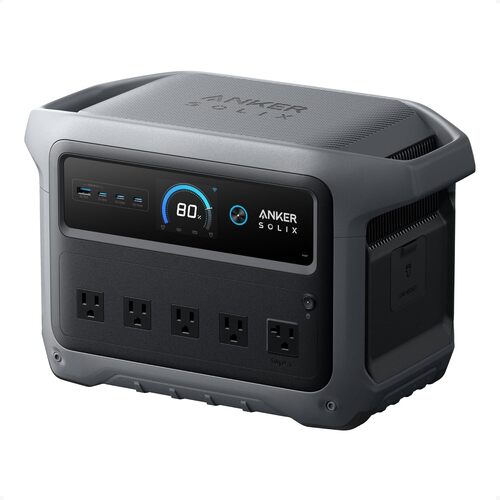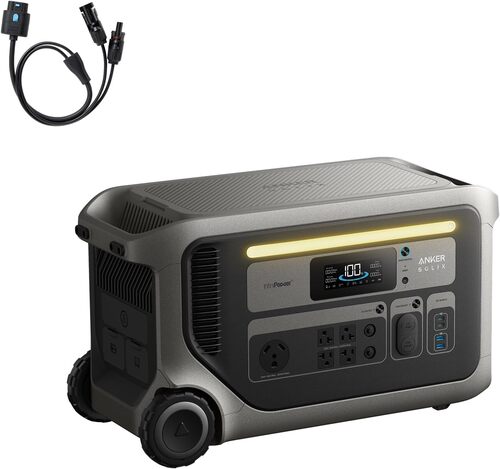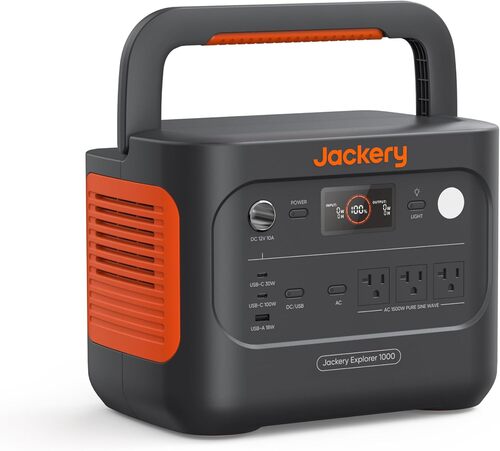
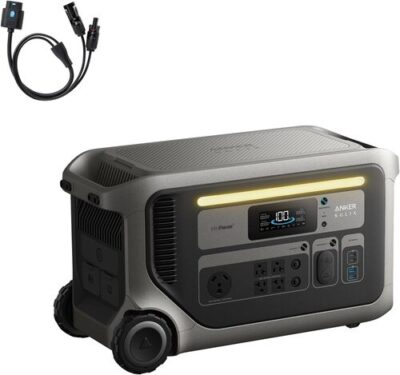
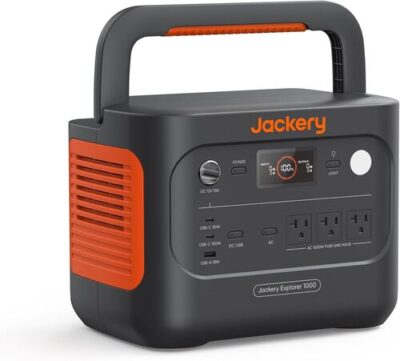
Anker vs Jackery power station is represented here by Anker SOLIX C1000 Gen 2 and F3000, plus Jackery Explorer 1000 v2. That lineup cannot produce one fair brand score: two products are carryable 1kWh stations, while F3000 is a 3,072Wh, 3,600W, 91.49-pound RV and backup platform.
Carryable 1kWh match
C1000 Gen 2 versus Explorer 1000 v2: output, weight, charging, ports, and intended loads decide.
Large-system question
Anker F3000 belongs against other 3kWh RV/home-backup systems, not against the Jackery 1kWh product selected here.
The shared specification table below keeps the products visible without embedding another grid in the body. The editorial task is to prevent a brand-level shortcut from hiding capacity class, portability, and system integration.
Anker vs Jackery: Three Missions, Not One Brand Winner
Fast answer: Pick Anker if charging speed, solar input, output headroom, and expansion matter most. Pick Jackery if you want a more straightforward camping or RV backup setup. Neither brand replaces a professionally installed whole-home battery system, but both can cover important essentials.
The Selected Products Occupy Unequal Tiers
Anker and Jackery both make practical power stations, but they don’t feel aimed at exactly the same buyer.
Anker looks stronger when you care about charging speed, solar input, app control, and bigger-system planning. Our Anker SOLIX C1000 Gen 2 lab notes covers fast-charge performance. The C1000 Gen 2 charges very quickly for a 1kWh-class model, while the F3000 gives solar users much more input headroom. See our Anker SOLIX F3000 backup review for RV and outage use.
Jackery looks stronger when you want a familiar camping battery or a straightforward RV backup station. The Explorer 1000 V2 is the easier travel pick, while the HomePower 3000 has a TT-30 RV port that matters more than another USB port if you own a trailer.
That’s the practical split. Anker feels more flexible and technical. Jackery feels more direct and RV-friendly.
Mission One: Carryable 1kWh Power
| 1kWh decision | Anker C1000 Gen 2 | Jackery Explorer 1000 v2 |
|---|---|---|
| Nominal energy | 1,024Wh | 1,070Wh |
| Continuous output | 2,000W | 1,500W |
| Carry weight | 24.9 lb | 23.8 lb |
| Solar ceiling | 600W | 400W |
| Best reason | More output and solar recovery | Slightly lower weight and simple 1kWh mission |
These figures define the shortlist, not the final compatibility result. Measure startup watts, simultaneous load, daily watt-hours, required ports, and available solar window.
Mission Two: Large RV and Outage Reserve
At 91.49 pounds, F3000 should be planned around wheels, storage, cable clearance, and a repeatable deployment route. Its 240V capability requires a two-unit configuration according to the retained record, so one product title must not be read as whole-home compatibility.
A bigger battery gives you more time, but only if the appliance draw stays reasonable. That’s why a 3kWh unit can feel huge for routers and lights, yet still drain quickly with a heater or electric cooking appliance.
The Anker SOLIX C1000 Gen 2 and Jackery Explorer 1000 V2 sit in the practical 1kWh class. They’re good for CPAP machines, laptops, phones, lights, routers, Starlink, coolers, and short fridge backup. They’re not ideal for long heater use.
The Anker SOLIX F3000 and Jackery HomePower 3000 move into serious backup territory. At 3,072Wh each, they make more sense for refrigerator backup, RV appliances, longer outages, and heavier mixed loads.
These are estimates based on listed capacity, typical inverter losses, and a small battery reserve — not measured runtimes. Refrigerator and cooler runtime can swing a lot because compressors cycle on and off.
Inverter Headroom Must Be Paired With Energy
Output matters because it tells you what the power station can run at all. Capacity tells you how long it might run.
The Anker SOLIX C1000 Gen 2 has a clear edge over the Jackery Explorer 1000 V2 for continuous output. Anker gives you 2,000W continuous output, while Jackery gives you 1,500W. Both list 3,000W surge, but Anker’s higher continuous rating helps with coffee makers, tools, microwaves, and mixed loads.
The large-model comparison is closer. Anker SOLIX F3000 and Jackery HomePower 3000 both list 3,600W continuous output. However, Jackery lists a 7,200W surge rating, while the provided Anker F3000 data does not list surge output.
For real buyers, that means:
- Phones, laptops, routers, lights: all four can handle them
- CPAP machines and coolers: all four may work, but bigger batteries last longer
- Fridges and freezers: 1kWh units can do short backup; 3kWh units are better
- Kettles, heaters, air fryers: large models can run them briefly, but runtime drops fast
- RV loads: Jackery HomePower 3000 has the cleanest plug advantage because of TT-30
Appliance winner: Anker wins the 1kWh output matchup. Jackery wins the 3kWh surge-and-RV convenience matchup.
Mission Three: Recovery Speed and Solar Design
C1000 Gen 2’s 600W solar ceiling exceeds Explorer 1000 v2’s 400W, while F3000’s 2,400W belongs to a much larger system. More input is useful only when compatible panels and sun can supply it.
Charging behavior is where Anker starts to separate itself. That matters if you’re preparing for storms, using a generator for short refill windows, or trying to recover during a sunny day off-grid.
Wall Charging — Anker Vs Jackery
The Anker SOLIX C1000 Gen 2 is the fastest clear spec here, with a 49-minute fast AC recharge. That’s excellent if you forget to charge before a trip or need a quick top-off before the next outage wave.
The Jackery Explorer 1000 V2 is also fast, with a roughly one-hour emergency fast mode. The Jackery HomePower 3000 takes about 2.2 hours from AC, which is still solid for a 3kWh unit.
The Anker SOLIX F3000 lists high-power generator and pass-through charging, but the provided data does not give a clean full-recharge time. Buyers should confirm the latest Anker documentation before planning around exact refill windows.
Solar Charging — Anker Vs Jackery
Solar is the biggest brand split in this selected group. The Anker SOLIX F3000 supports up to 2,400W solar input, which gives it serious off-grid potential. The Anker SOLIX C1000 Gen 2 supports up to 600W.
Jackery is more modest here. The Explorer 1000 V2 supports up to 400W, and the HomePower 3000 is listed with a 400W solar setup using two 200W SolarSaga panels.
A rough solar rule helps: divide battery capacity by solar input, then add real-world losses. Sun angle, shade, heat, clouds, and panel compatibility all matter.
Car Charging — Anker Vs Jackery
Car charging is useful, but it’s slow from a standard 12V outlet. It works for road-trip top-offs, not as the main refill plan for a 3kWh station.
Charging winner: Anker wins overall because of the C1000 Gen 2’s fast AC recharge and the F3000’s much higher solar ceiling.
A 24-Pound Carry Is Not a 91-Pound Installation
Portability is easy to overrate on a product page. A 24 lb battery and a 90 lb battery both count as “portable,” but they don’t fit the same lifestyle.
- Under 10 lb: easy grab-and-go power
- 10-30 lb: realistic for car camping and room-to-room use
- 30-50 lb: still movable, but not fun to carry far
- 50+ lb: better treated as semi-portable backup power
- 100+ lb: wheels matter more than handles
The Jackery Explorer 1000 V2 weighs 23.8 lb, and the Anker SOLIX C1000 Gen 2 weighs 24.9 lb. That’s a very close fight, although Jackery gets the slight carry advantage.
The bigger models are very different. The Jackery HomePower 3000 weighs 59.52 lb, which is heavy but still cart-friendly. The Anker SOLIX F3000 weighs 91.49 lb, so wheels and a pull handle become essential rather than optional.
Portability winner: Jackery wins for lighter carry. Anker F3000 only makes sense if you value rolling mobility more than lifting.
LFP Is the Starting Point, Not the Verdict
Battery chemistry affects how a power station ages. LiFePO4 batteries are heavier, but they usually last much longer than older NMC lithium-ion packs.
That’s why the 1kWh matchup is encouraging. The Anker SOLIX C1000 Gen 2 uses LiFePO4 and lists 4,000 cycles to at least 80% capacity. The Jackery Explorer 1000 V2 also uses LiFePO4, with 4,000 cycles to 70% capacity listed.
The Jackery HomePower 3000 also uses LiFePO4 and lists 4,000 cycles to 70%. The only uncertainty is the Anker SOLIX F3000, because the provided listing does not specify battery chemistry or cycle life.
If you’ll use the power station often, LiFePO4 is usually the safer long-term bet.
Simplicity Versus Configuration Friction
Small features can matter more than big numbers once the power goes out. You’ll notice outlet spacing, display clarity, fan noise, app pairing, and whether the right port exists for your setup.
Anker’s strength is control. The C1000 Gen 2 includes app support, Wi-Fi, Bluetooth, charge-rate control, TOU mode, and UPS-style switchover under 10ms. The F3000 also supports the Anker app, power-saving modes, charge-rate controls, and pass-through charging.
Jackery’s strength is direct usefulness. The Explorer 1000 V2 is easy to understand, while the HomePower 3000 adds the big practical RV feature: a TT-30 port. If you own a travel trailer, that can matter more than an extra USB port.
For CPAP or bedroom use, fan noise still matters. Fast charging usually makes any brand louder, so slower charging is often the better overnight setting.
Usability winner: Anker wins for smart controls. Jackery wins for RV plug convenience and simpler use.
Commissioning Reveals the Better Ownership Fit
A spec table can’t tell you everything. It won’t show how annoying a fan sounds beside a bed, how easy the app is during an outage, or whether your solar panels need adapters.
Buyers should know three things before choosing:
- Solar compatibility can get confusing. Check voltage, connectors, and panel limits before buying third-party panels.
- UPS mode is not always the same as a dedicated UPS. Test routers, CPAP machines, and desktop computers before relying on them.
- Large batteries still drain fast with heat loads. Heaters, kettles, ovens, and air fryers are brutal on runtime.
This is why the “better” brand depends on your setup. Anker gives you more power-system flexibility. Jackery often gives you a cleaner path for camping and RV use.
The Mission-Matched Price Rule
Compare C1000 Gen 2 and Explorer 1000 v2 as carryable 1kWh systems. Compare F3000 only against systems that also provide the required 3kWh energy, RV outlet, output, expansion, and charging topology.
Include panels, cable kits, protected distribution, expansion, vehicle charging, and any accessibility cost created by weight. A cheaper product in the wrong tier is not value.
Price changes constantly in this category, so don’t rely on list price alone. Instead, compare current sale price against capacity, output, battery chemistry, solar input, warranty, and whether you’ll use expansion.
$/Wh is helpful, but it doesn’t capture everything. A model with a higher price can still be the better value if it has better output, faster charging, a longer lifespan, or the exact RV port you need.
Final acceptance test: weigh the actual travel bundle, carry it over the real route, connect every intended device, time one representative duty cycle, and restore the consumed energy from the planned source. For F3000, include the RV or large-backup interface and expansion plan rather than testing only a wall outlet.