Solar Power Picks logo with sun, solar panel, and green energy icon

  • Home
  • Reviews
  • Best
    • Best portable power stations
  • Guides
    • Portable Power Stations Guides
  • Comparisons
    • Portable Power Stations Comparisons
  • Calculator

Best 2000W Portable Power Station: High-Output Picks That Make Sense

OUR PICKS

Anker SOLIX C1000 Gen 2 Review: Fast-Charging Backup Power That Actually Feels Useful

Best Overall 2000W Pick

Anker SOLIX C1000 Gen 2 Review: Fast-Charging Backup Power That Actually Feels Useful

Check price at Amazon Jump to details
Anker SOLIX C1000 Review: Fast-Charging Backup Power That Actually Fits Real Life

Best Older-Model Deal

Anker SOLIX C1000 Review: Fast-Charging Backup Power That Actually Fits Real Life

Check price at Amazon Jump to details
EcoFlow Delta 2 Max Review: Fast-Charging Backup for Blackouts, RVs, and Camping

Best 2000W Pick with More Capacity

EcoFlow Delta 2 Max Review: Fast-Charging Backup for Blackouts, RVs, and Camping

Check price at Amazon Jump to details
AFERIY P210 Review: A Quiet 2048Wh Backup Station for RVs, Outages, and Off-Grid Weekends

Best 2kWh Value Pick

AFERIY P210 Review: A Quiet 2048Wh Backup Station for RVs, Outages, and Off-Grid Weekends

Check price at Amazon Jump to details
OUPES Mega 1 Review: Fast 1kWh Backup Power With Real Trade-Offs

Best Budget 2000W-Class Pick

OUPES Mega 1 Review: Fast 1kWh Backup Power With Real Trade-Offs

Check price at Amazon Jump to details

The best 2000W portable power station is not automatically the biggest battery — it’s the one that can actually hold a 2000W-class load without tripping, overheating, or draining faster than you expected.

That’s the key difference with this article. We’re not asking, “What is the best portable power station overall?” We’re asking a narrower question: which units make the most sense when you specifically need around 2000W of usable AC output? Start with our top portable power station picks if you’re still choosing a size.

That matters if you want to run a microwave, coffee maker, kettle, power tool, fridge compressor, RV appliance, or several smaller loads at once. In practice, a good best 2000W portable power station pick needs enough inverter headroom first — and enough battery capacity second.

⚠️ Load Warning: 2000W is an output rating, not a runtime promise. A 2000W appliance can drain a 1000Wh station in well under an hour after losses.

Fast Picks for the 2000W Class

PickProductWhy It Fits
Best Overall 2000W-Class PickAFERIY P2102048Wh battery, 2400W output, strong value
Best Lightweight High-Output PickAnker SOLIX C1000 Gen 22000W output in a 24.9 lb body
Best Expandable 1kWh PickAnker SOLIX C1000Not quite 2000W, but strong 1800W output and expansion support
Best Solar-Friendly 2kWh PickEcoFlow Delta 2 Max2048Wh capacity, 2400W output, 1000W solar ceiling
Best Budget 2000W PickOUPES Mega 12000W pure-sine output with lower entry cost

Need exact runtime math? Use the calculator here: portable power station size calculator.

2000W Comparison Snapshot

ProductCapacityContinuous AC OutputSurge / BoostSolar InputWeightBest Use
AFERIY P2102048Wh2400W4800WAbout 500W54 lbRVs, outages, tools
Anker SOLIX C1000 Gen 21024Wh2000W3000W600W24.9 lbPortable 2000W power
Anker SOLIX C10001056Wh1800W2400W600W28.44 lbExpandable 1kWh setup
EcoFlow Delta 2 Max2048Wh2400W4800W1000W50.7 lbSolar, fridge backup, RVs
OUPES Mega 11024Wh2000W4500WUp to 800W27.8 lbBudget high-output use

The 2000W Rule: Match the Appliance First

A 2000W-class power station is for loads that smaller units struggle with. Think microwave bursts, drip coffee makers, electric kettles, circular saws, sump pumps, fridge compressors, and RV appliances that spike when they start.

The mistake is shopping like wattage and battery size are the same thing. They’re not. Watts decide whether the appliance runs. Watt-hours decide how long it runs.

📌 Runtime Reality: A 1200W coffee maker used for 10 minutes may only use around 200Wh after losses. For more examples, see how long a power station actually runs. A 1500W space heater running continuously can destroy your battery percentage.

1kWh vs 2kWh: The Real Decision

For the best 2000W portable power station, the biggest decision is not brand. It’s whether you want a lighter 1kWh unit or a heavier 2kWh unit.

A 1kWh station makes sense if you need high output in short bursts. The Anker SOLIX C1000 Gen 2 and OUPES Mega 1 fit that style well. They can run demanding appliances, but you should treat cooking, heating, and tool use as short sessions.

A 2kWh station makes more sense if runtime matters. The AFERIY P210 and EcoFlow Delta 2 Max are heavier, but they’re better for fridge backup, RV weekends, Starlink, CPAP, fans, lights, and mixed outage loads. Our EcoFlow Delta 2 Max deep dive covers real outage performance.

If You Need…Better Choice
Lighter carrying1kWh 2000W-class station
Longer fridge runtime2kWh station
Short microwave / coffee use1kWh can work
RV or blackout essentials2kWh is safer
Best solar recoveryEcoFlow Delta 2 Max
Lowest cost per useful outputOUPES Mega 1 or AFERIY P210

Buyer Shortcut: What to Check Before Buying

  • ✅ Continuous output: Look for 2000W or higher if that’s the goal.
  • ✅ Battery size: 1kWh is for bursts; 2kWh is for runtime.
  • ✅ Pure sine wave: Important for fridges, CPAP machines, tools, and electronics.
  • ✅ Solar input: Useful only if the ceiling is high enough for the battery size.
  • ⚠️ Surge rating: Helpful, but don’t treat it like continuous power.
  • ⚠️ UPS mode: Test it before trusting it with important loads.
  • ❌ Space heaters: They work, but they’re usually a terrible use of battery power.

Where Solar Fits in a 2000W Article

Solar matters less for the “2000W” part and more for the “how do I refill this thing?” part. A 200W panel can help a 1kWh station, but it’s slow for 2kWh batteries.

For serious off-grid use, EcoFlow Delta 2 Max has the best solar ceiling here. OUPES Mega 1 also looks strong on paper, while AFERIY P210 is better if wall charging is your main plan. Unsure between Anker and EcoFlow at this wattage? Read our Anker versus EcoFlow showdown.

Solar SetupPractical Fit
100WEmergency top-off only
200WUseful for 1kWh stations
400WBetter match for 2kWh stations
800W+Real daily recovery potential

🔌 Buyer Shortcut: For a 2kWh battery, don’t expect a small 100W panel to save the day. It may help, but it won’t refill the station quickly.

Best Overall 2000W Pick

Anker SOLIX C1000 Gen 2 Review: Fast-Charging Backup Power That Actually Feels Useful

Anker SOLIX C1000 Gen 2 Review: Fast-Charging Backup Power That Actually Feels Useful

Get it now:

Check latest price

What to know

  • 1,024Wh LiFePO4 battery with 2,000W output for appliance bursts
  • 49-minute AC recharge helps during generator-assisted outages
  • 600W solar input via XT60-style solar connection
  • Under-10ms UPS-style switchover for routers, CPAP, and office gear
  • 24.9 lb body is light for this output class

Best if

  • You want one carryable 2,000W station for fridges, CPAP, and RV weekends
  • You value fast AC recharge for storm prep and generator windows
  • You run Starlink, routers, laptops, and small appliances together

Skip if

  • You need expandable capacity for multi-day outages
  • Fast-charge fan noise will bother you in a bedroom
  • You expect long runtime from heaters, ovens, or kettles

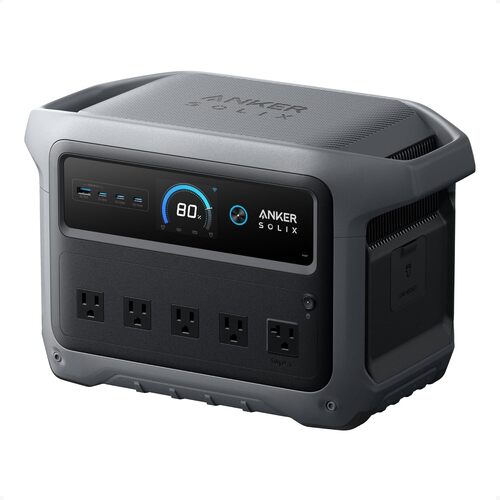
The Anker SOLIX C1000 Gen 2 is the best overall 2000W pick because it combines true 2000W-class output with a carryable 1kWh LiFePO4 battery. It’s built for buyers who want one portable power station for short blackouts, CPAP backup, RV weekends, Starlink, and small appliances without jumping to a 50 lb 2kWh box.


In practice, the Anker unit works because the 1,024Wh battery, 2,000W inverter, 49-minute AC recharge, and 600W solar input all fit the same “ready again fast” use case. That said, the C1000 Gen 2 isn’t expandable, so longer outages may push you toward a bigger battery or a second unit.

Capacity1,024Wh
AC Output2,000W continuous, 3,000W surge (sine-wave behavior reported; pure sine not explicitly listed)
Solar Input600W max via XT60-style solar input
Weight24.9 lb (11.3 kg)
BatteryLiFePO4 (4,000 cycles to 80%)
Best Older-Model Deal

Anker SOLIX C1000 Review: Fast-Charging Backup Power That Actually Fits Real Life

Anker SOLIX C1000 Review: Fast-Charging Backup Power That Actually Fits Real Life

Get it now:

Check latest price

What to know

  • 1056Wh LiFePO4 battery with 1800W pure-sine AC output
  • Fast AC recharge reaches full in about 58 minutes
  • 600W solar input via XT60 and 11–60V MPPT support
  • Expandable to 2112Wh with Anker’s add-on battery
  • Built-in light helps during blackouts and campsite setup

Best if

  • You want a discounted Anker unit for camping, fridge backup, and short outages
  • You like the option to add an expansion battery later
  • You want six AC outlets and a built-in emergency light

Skip if

  • You specifically need 2,000W continuous output instead of 1,800W
  • You’d rather avoid buying brand-specific expansion hardware
  • You need a lighter 1kWh station for frequent carrying

The Anker SOLIX C1000 earns the older-model deal badge because it still delivers serious portable power station performance when the price is right. It’s a smart fit for buyers who want Anker reliability, LiFePO4 chemistry, strong AC output, and solar support without needing the newest C1000 Gen 2.


Here’s why that matters: the C1000 gives you 1056Wh, 1800W pure-sine output, six AC outlets, a useful built-in light, and fast wall charging in about an hour. Worth knowing, it’s not technically a 2000W continuous unit, so the deal only makes sense if 1800W covers your appliances.

Capacity1056Wh (expandable to 2112Wh)
AC Output1800W continuous, 2400W surge (pure sine)
Solar Input600W max via XT60
Weight28.44 lb (12.9 kg)
BatteryLiFePO4 (3,000 cycles to 80%)
Best 2000W Pick with More Capacity

EcoFlow Delta 2 Max Review: Fast-Charging Backup for Blackouts, RVs, and Camping

EcoFlow Delta 2 Max Review: Fast-Charging Backup for Blackouts, RVs, and Camping

Get it now:

Check latest price

What to know

  • 2048Wh LiFePO4 battery gives stronger fridge and outage runtime
  • 2400W output handles appliances, tools, and RV loads
  • 1000W solar input supports faster off-grid recovery
  • Expandable to 6144Wh with two add-on batteries
  • 50.7 lb body is better parked than carried

Best if

  • You’re powering a fridge, CPAP, router, and lights through longer outages
  • You plan to use larger solar arrays or add expansion batteries
  • You need 2400W output for tools, microwaves, or RV appliances

Skip if

  • You want a one-hand 1kWh station for quick car camping
  • You prefer the simplest setup with no extra cables or batteries
  • You’re relying on critical unattended loads without testing first

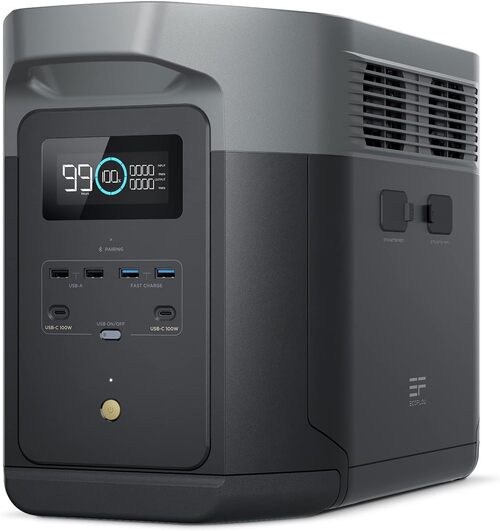
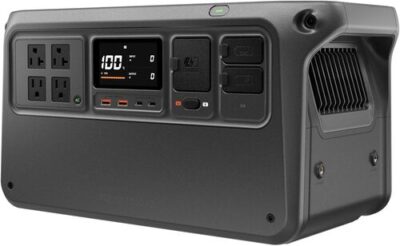
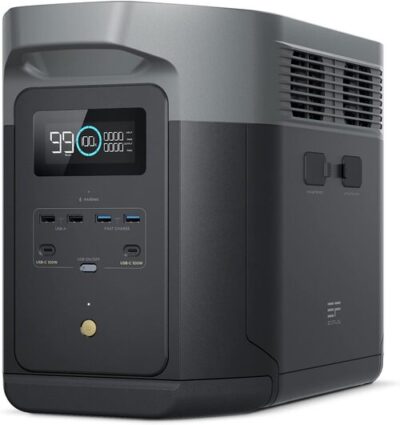
The EcoFlow Delta 2 Max is the better 2000W pick when runtime matters more than carrying weight. It’s designed for outage-prep buyers, RV owners, and campers who want a 2kWh LiFePO4 power station that can keep fridges, routers, CPAP machines, fans, and lights going longer than a 1kWh unit.


The real benefit shows up when you combine its 2048Wh capacity, 2400W AC output, expandable battery system, and 1000W solar ceiling. EcoFlow also gives you app control and adjustable charging, which helps with generators. The catch: at about 50.7 lb, the Delta 2 Max is portable by handles — not fun to carry far.

Capacity2048Wh (expandable to 6144Wh)
AC Output2400W continuous, 4800W surge / 3400W X-Boost (pure sine not specified)
Solar Input1000W max via XT60i / MC4 adapter setup
Weight50.7 lb (23 kg)
BatteryLiFePO4 (3,000 cycles to 80%)
Best 2kWh Value Pick

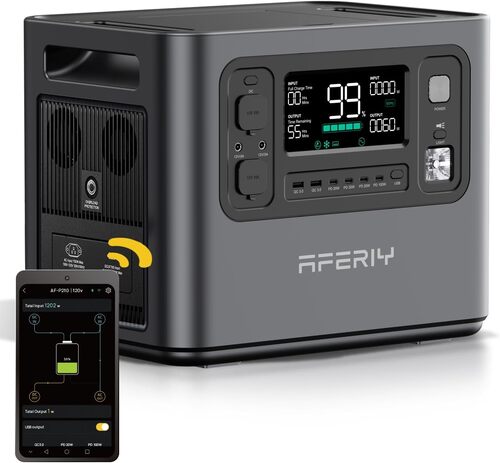
AFERIY P210 Review: A Quiet 2048Wh Backup Station for RVs, Outages, and Off-Grid Weekends

AFERIY P210 Review: A Quiet 2048Wh Backup Station for RVs, Outages, and Off-Grid Weekends

Get it now:

Check latest price

What to know

  • 2048Wh LiFePO4 capacity fits RVs, outages, and cabin weekends
  • 2400W pure-sine output supports appliances, pumps, and tools
  • Fast AC charging reaches full in roughly two hours
  • 500W solar input is useful but not class-leading
  • 54 lb weight makes a cart helpful indoors

Best if

  • You want 2kWh capacity for RV loads, Starlink, fridges, and CPAP backup
  • You value a strong 2400W inverter at a value-focused price
  • You’ll mostly run it from battery power during outages

Skip if

  • You need a lightweight unit you’ll move around daily
  • You want polished app setup and brand-name support consistency
  • You need full 2400W performance while using UPS/pass-through mode

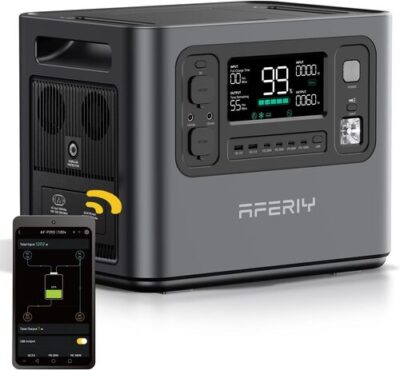
AFERIY P210 is the best 2kWh value pick because it gives you big-battery runtime and a stronger-than-2000W inverter without moving into premium-brand pricing. It’s built for RV owners, blackout-prep households, ham radio users, Starlink setups, and off-grid weekend cabins that need more than a compact 1kWh box.


The spec-to-benefit story is simple: 2048Wh helps with overnight essentials, while 2400W pure-sine output gives the AFERIY unit room for microwaves, coffee makers, sump pumps, and tools. Just know the P210 is heavy, and UPS/pass-through use appears more limited than battery-only output.

Capacity2048Wh
AC Output2400W continuous, 4800W surge (pure sine)
Solar InputAbout 500W max via XT90-style / adapter-based solar setup
Weight54 lb (24.5 kg)
BatteryLiFePO4 (3,500+ cycles claimed)
Best Budget 2000W-Class Pick

OUPES Mega 1 Review: Fast 1kWh Backup Power With Real Trade-Offs

OUPES Mega 1 Review: Fast 1kWh Backup Power With Real Trade-Offs

Get it now:

Check latest price

What to know

  • 1024Wh LiFePO4 battery with 2000W pure-sine AC output
  • 0–80% AC recharge in about 36 minutes claimed
  • 800W solar input reported via MC4-to-Anderson cable
  • Expandable up to 5120Wh with OUPES B2 batteries
  • 27.8 lb weight is manageable for car camping

Best if

  • You want budget-friendly 2000W output for short outages and camping
  • You like fast charging and the option to expand later
  • You’re powering routers, Starlink, laptops, sump pumps, or fridge cycles

Skip if

  • You need 2kWh runtime from the base unit
  • You don’t want to pay extra for add-on batteries
  • You expect the 4500W surge rating to handle every startup load

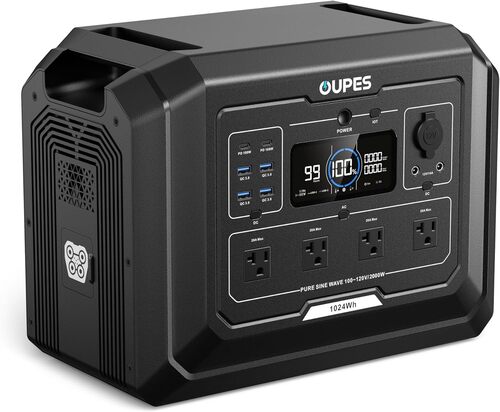
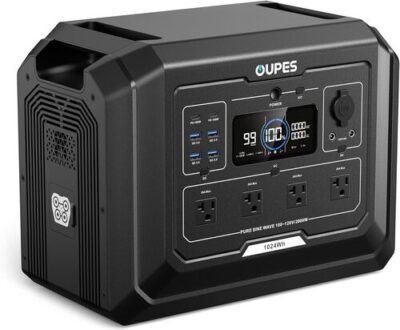
OUPES Mega 1 is the best budget 2000W-class pick because it puts a 2000W pure-sine inverter into a manageable 1kWh LiFePO4 power station. It’s a good fit for buyers who want affordable backup for short outages, truck camping, Starlink, sump pumps, routers, laptops, and fridge support.


OUPES Mega 1 stands out because it pairs fast AC charging with expansion support and a surprisingly high claimed surge rating. At the same time, the Mega 1 is still a 1024Wh unit, so it won’t deliver 2kWh-style runtime unless you add batteries. One thing: treat the 4500W surge claim cautiously and plan around 2000W continuous.

Capacity1024Wh (expandable to 5120Wh)
AC Output2000W continuous, 4500W surge (pure sine)
Solar Input800W max via MC4-to-Anderson cable
Weight27.8 lb (12.6 kg)
BatteryLiFePO4 (3,500+ cycles claimed)

Product Comparison

Feature Anker SOLIX C1000 Gen 2 Review: Fast-Charging Backup Power That Actually Feels Useful Anker SOLIX C1000 Review: Fast-Charging Backup Power That Actually Fits Real Life EcoFlow Delta 2 Max Review: Fast-Charging Backup for Blackouts, RVs, and Camping AFERIY P210 Review: A Quiet 2048Wh Backup Station for RVs, Outages, and Off-Grid Weekends OUPES Mega 1 Review: Fast 1kWh Backup Power With Real Trade-Offs
Product Image
Anker SOLIX C1000 Gen 2 Review: Fast-Charging Backup Power That Actually Feels Useful
Anker SOLIX C1000 Review: Fast-Charging Backup Power That Actually Fits Real Life
EcoFlow Delta 2 Max Review: Fast-Charging Backup for Blackouts, RVs, and Camping
AFERIY P210 Review: A Quiet 2048Wh Backup Station for RVs, Outages, and Off-Grid Weekends
OUPES Mega 1 Review: Fast 1kWh Backup Power With Real Trade-Offs
Price $799 $449.99 $1299 $639.99 $1399.99 $899 $669 $549 $449
Rating
4.7 / 5
4.5 / 5
4.3 / 5
4.5 / 5
4.6 / 5
Category Portable Power Stations Portable Power Stations Portable Power Stations Portable Power Stations Portable Power Stations
Brand Anker Anker EF ECOFLOW AFERIY OUPES
Model / SKU Anker SOLIX C1000 Gen 2 / A1763 (ASIN: B0FN7MSY4L) Anker SOLIX C1000 / A1761 (ASIN: B0CDGKRX4X) DELTA2 Max / EFD350 (ASIN: B0C4DW17PD) P210 (ASIN: B0DRYQSXWV) Mega 1 / S1 (ASIN: B0DG8JQNS4)
Battery capacity 1,024 Wh 1056 Wh 2048 Wh 2048 Wh 1024 Wh
Battery chemistry LiFePO4 (LFP) LiFePO4 (LFP) LiFePO4 (LFP) LiFePO4 (LFP) LiFePO4 (LFP)
Cycle life 4,000 cycles to at least 80% capacity (claimed) 3,000 cycles to 80% capacity (claimed) 3000 cycles to 80% capacity (claimed) 3500+ cycles (claimed) 3500+ cycles (claimed)
Expandable battery No (customers note this model does not support expansion batteries) Yes — supports Anker expansion battery for up to 2112Wh total (expansion battery sold separately) Yes — supports up to 2 expansion batteries (up to 6144 Wh total) No (some owners wish this version supported expansion) Yes — supports up to 2 B2 expansion batteries, up to 5120Wh total (claimed)
AC output 2,000 W continuous (sine-wave behavior reported by customer testing; pure sine not explicitly listed in provided specs) 1800 W continuous (pure sine wave) 2400 W continuous (120V AC; pure sine wave not specified in supplied data) 2400 W continuous (pure sine wave) 2000 W continuous (pure sine wave)
Surge output 3,000 W peak 2400 W peak (SurgePad) 4800 W starting wattage (3400 W via X-Boost for some high-wattage appliances) 4800 W peak 4500 W peak (claimed; customer surge results vary)
AC outlets Not specified (10 total ports claimed) 6 × 120V AC outlets 6 × 120V AC outlets 6 × 120V AC outlets 4 × 120V AC outlets
USB-C ports 2 × USB-C (up to 140W reported by owners) 2 × USB-C (1 × 100W, 1 × 30W) 2 × USB-C (100W PD mentioned in customer feedback) 4 × USB-C (includes 100W and 20W outputs) Count not specified (customer mentions 140W USB-C)
USB-A ports Not specified (USB-A support reported by owners) 2 × USB-A (12W each / 24W total) 4 × USB-A (2 standard + 2 fast-charge mentioned in customer feedback) 2 × USB-A Not specified
12V car socket 1 × 12V/10A car port (customer-reported) 1 × 12V/10A car port 1 × 12V car port 1 × 12V car outlet Yes (12V car charging cable included; output details not fully specified)
Max solar input 600 W (60V max, MPPT behavior implied by solar charging use) 600 W (XT60, 11–60V MPPT) 1000 W (dual 500 W inputs; XT60i / MC4 adapter setup may be needed) About 500 W (owner-reported solar limit; panel matching may require an adapter) 800 W (reported by owner; MC4-to-Anderson cable included)
Max AC input 1,600 W (HyperFlash fast charging enabled in the Anker app) 1300 W (UltraFast AC recharge mode) 1800 W (fast AC charging, adjustable in app) 1100 W (adjustable charge rate reported by owners) 1400 W (reported by owner; fast AC charging supported)
AC recharge time 49 minutes (fast mode) ~58 minutes fast charge (100% with UltraFast mode enabled through app) About 1-1.5 hours (fast mode; varies by input setting and starting charge) About 2 hours (high AC charge setting) 0-80% in 36 minutes (claimed); roughly 45-90 minutes reported depending on mode
Solar recharge time About 1.8 hours with up to 600W solar (ideal conditions) ~1.8 hours with 600W solar input (ideal sun); longer with the included 200W panel About 2.5-3.5 hours with full 1000 W solar in ideal sun (real-world conditions vary) About 4-6 hours with maximum solar in strong sun (real time depends on panels, voltage, and weather) ~1.5-2 hours with 800W ideal input; ~5-7 hours with 200W panels in good sun (real sun varies)
UPS / EPS support Yes — under 10 ms switchover (claimed) Yes — 20ms switchover (UPS/EPS-style backup) Yes — EPS-style pass-through support (customer feedback is mixed for critical unattended loads) Yes — less than 10ms claimed switchover (UPS load limit and reliability complaints reported by some owners) Yes — less than 20ms switchover (claimed)
App support Yes — Anker app with Wi-Fi and Bluetooth Yes — Anker app (charging speed, live status, remote monitoring) Yes — EcoFlow app (Wi-Fi / Bluetooth control and monitoring) Yes (BrightEMS app mentioned by owners) Yes — Bluetooth app control (Wi-Fi / Bluetooth feedback is mixed)
Built-in light No Yes — front LED light / bar light No (not specified in supplied product data or customer feedback) Yes (brightness not a major strength) Not specified
Weight 24.9 lb 28.44 lb / 12.9 kg (Amazon listing shows 27.59 lb) 23 kg / about 50.7 lb 54 lb (listed; many owners describe it as roughly 50 lb class) 27.8 lb
Best for CPAP backup, routers and Starlink, short blackouts, fridge backup, RV camping, van life, truck camping, remote work, and small-appliance use Camping, RV boondocking, apartment backup, fridge backup, CPAP overnight power, routers, lights, coffee makers, short blackouts, and quiet indoor emergency power Home outage backup, refrigerators, CPAP machines, Wi-Fi routers, RVs, camping, van life, sailboat work, hurricane prep, and generator-assisted emergency systems RV backup, camping, CPAP backup, refrigerators, routers, TVs, Starlink, ham radio, off-grid cabins, sump pumps, and short-to-medium blackouts Camping, truck camping, short blackouts, refrigerator backup, sump pump support, Starlink, routers, laptops, mobile work, and emergency prep
Buy Now View Deal View Deal View Deal View Deal View Deal

Bottom Line

If you want one best 2000W portable power station pick that feels strongest for the category, choose the AFERIY P210. It has the right mix of 2048Wh capacity, 2400W continuous output, LiFePO4 chemistry, and value.

If weight matters more, go with the Anker SOLIX C1000 Gen 2. If solar and expansion matter more, choose the EcoFlow Delta 2 Max. And if you want the cheapest way into true 2000W output, the OUPES Mega 1 is the one to watch.

Frequently Asked Questions

What is the best 2000W portable power station?

The best 2000W portable power station depends on whether you want runtime or portability. The AFERIY P210 is the strongest overall value because it pairs 2048Wh capacity with 2400W output. The Anker SOLIX C1000 Gen 2 is better if you want a lighter 2000W unit. The EcoFlow Delta 2 Max is the better solar-friendly 2kWh pick, while the OUPES Mega 1 is the value option for buyers who want 2000W output at a lower price.

Is 2000W enough to run appliances?

Yes, 2000W is enough for many common appliances, including coffee makers, microwaves, fridges, small power tools, Starlink, laptops, fans, routers, and CPAP machines. The catch is runtime. A 2000W inverter can run the appliance, but a 1000Wh battery may not run it for long. For short appliance bursts, 1kWh can work. For fridge backup or RV use, 2kWh is usually more practical.

Can a 2000W portable power station run a microwave?

Yes, many 2000W portable power stations can run a microwave, as long as the microwave’s running wattage stays under the station’s continuous AC output. Most microwaves pull around 800W to 1500W while operating. However, repeated microwave use drains capacity quickly. A 1200W microwave used for 10 minutes can consume roughly 200Wh after losses, so it is fine for short heating sessions but not ideal for heavy cooking.

Is a 1000Wh 2000W power station enough?

Yes, if you need high output in short bursts. A 1000Wh 2000W power station can run appliances like coffee makers, microwaves, and tools, but it does not have huge runtime. It is better for car camping, short outages, and quick appliance use. If you want overnight fridge backup, longer RV use, or Starlink plus CPAP plus lights, a 2000Wh station is the safer choice. Running a fridge on 2000W output? See what it takes to power a refrigerator

Should I buy a 1kWh or 2kWh 2000W power station?

Buy 1kWh if you care about portability, price, and short high-output use. Buy 2kWh if you care about runtime, fridge backup, RV loads, or longer outages. A 1kWh station with 2000W output is like a compact high-power tool. A 2kWh station is more like a serious backup battery. For most buyers choosing this category, 2kWh is the better long-term fit unless weight is the main concern.

Are 2000W portable power stations good for RVs?

Yes, but battery size matters. A 2000W-class unit can run many RV-friendly loads, including lights, laptops, Starlink, fans, small appliances, and some cooking gear. For RV weekends, a 2kWh station like the AFERIY P210 or EcoFlow Delta 2 Max makes more sense than a smaller 1kWh unit. Also check whether you need a 30A RV outlet, because many portable stations only include standard AC outlets.

×

About Solar Power Picks

Portable Solar Power, Backup Power, and Off-Grid Gear Guides

Your trusted source for honest, in-depth product reviews and comparisons.

Quick Links

  • Best Picks
  • Reviews
  • Guides
  • Comparisons
  • Calculator
  • Privacy policy
  • Favorites

Categories

  • Portable Power Stations

© 2026 Solar Power Picks. All Rights Reserved.

We may earn a commission when you purchase through links on our site. Learn more