Renogy 50W Flexible Solar Panel Review: The Thinnest Way to Keep a 12V Battery Alive on a Curved Roof
At a Glance
KEY FEATURES
- Power output: 50 W (claimed), monocrystalline silicon
- Output: 12 V DC nominal; MC4 connectors (about 1 ft leads)
- Cell efficiency: 22% (high-tier monocrystalline)
- Weatherproofing: No certified IP rating stated — thin polymer laminate; rated for 2400 Pa wind and 5400 Pa snow loads
- Charge controller: None — direct MC4 output; pair with your own PWM or MPPT controller for battery charging
- Best for: Maintaining 12V marine, RV, and stored vehicle batteries on curved or weight-sensitive surfaces
PROS
- Thin, 2.87 lb laminate disappears on curved surfaces
- Output rivals rigid panels; keeps a 12V battery topped
- MC4 leads make parallel expansion easy
- Held output after a full year in Florida sun
- Rated for 2400 Pa wind and 5400 Pa snow, 5-year warranty
CONS
- Stiffer than expected — tight curves may not work
- 50W is trickle-class — not enough to run a fridge alone
- Cables about 1 ft; no controller or extensions included
- Some units arrive discolored; grommets loosen over time
- MC4 connector can fail after months of exposure
Editor's Choice
Based on rigorous testing & Amazon customer feedback
☀ Solar Panel Output Calculator
Estimate how much energy the Renogy 50W Flexible Solar Panel produces — and what it can power or charge.
Solar Setup
Portable devices
Power stations & batteries
Click devices to add them to your load list, adjust hours and quantity, then calculate.
Portable / Camping
Home Appliances
No devices added yet. Click chips above or add a custom device.
How many back-to-back sunless days should the battery keep you running? Example: 1 = one cloudy day, 3 = three cloudy days in a row.
Boat owners, van builders, and anyone babysitting a battery through the off-season keep reaching for a panel this small — 50 watts, under three pounds, thin enough to disappear — because they all have the same job in mind: keep a 12V battery from going flat on a surface where nothing rigid will fit. A rounded bimini top, a van roof, a boat cabin, a curved generator cover — that’s the home turf, and the work is trickle-charging and maintenance, not powering a whole rig.
You’ve seen the pitch. A monocrystalline panel that weighs under three pounds, sits a tenth of an inch tall, and bends onto surfaces that would crack a glass panel in half. On paper it promises rigid-panel output in a stealthy, near-invisible package. The catch is figuring out whether it’s flexible enough for your curve and powerful enough for your job.
Here’s the honest framing: it’s a maintenance panel, not a power plant. Topping off a stored battery or feeding light loads on a boat is where it shines, and owners genuinely praise its output for the size. But 50 watts has hard limits, the leads are short, and there’s no controller in the box — so knowing the trade-offs up front saves you a frustrating install.
Compare it directly with the other panels in our best flexible solar panels guide.
At a Glance
| Spec | Value |
|---|---|
| Max Power Output | 50 W (monocrystalline) |
| Output Voltage | 12 V DC nominal |
| Connector | MC4 (about 1 ft leads, no USB) |
| Cell Efficiency | 22% |
| Weatherproof Rating | No IP cert stated — rated 2400 Pa wind / 5400 Pa snow |
| Charge Controller | None — direct MC4 output |
| Cable Length | ~1 ft leads (extension usually needed) |
| Mount Type | Corner grommets + silicone adhesive (no bracket) |
| Best For | Maintaining 12V marine, RV, and stored vehicle batteries |
Quick Verdict on the Renogy 50W Flexible Solar Panel Review
Say yes if you want a thin, light panel to keep a 12V battery topped up on a curved surface — that’s exactly what the Renogy 50W Flexible Solar Panel does. It’s barely there at under three pounds, its output holds up against rigid panels, and owners report it keeping deep-cycle batteries charged through a full winter. Say no if you’re counting on one panel to run a fridge or you’re mounting to a tight bend: it’s stiffer than the photos suggest, the leads run about a foot long, and there’s no charge controller or cable in the box — so plan on buying those and confirming your curve isn’t too tight before you commit.
The Thin, Bendable Build Up Close
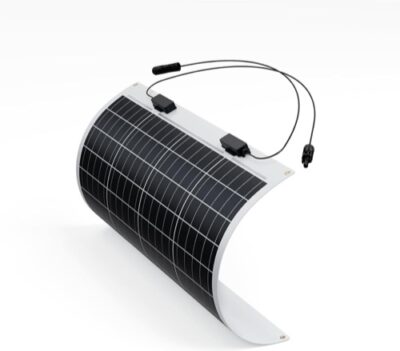
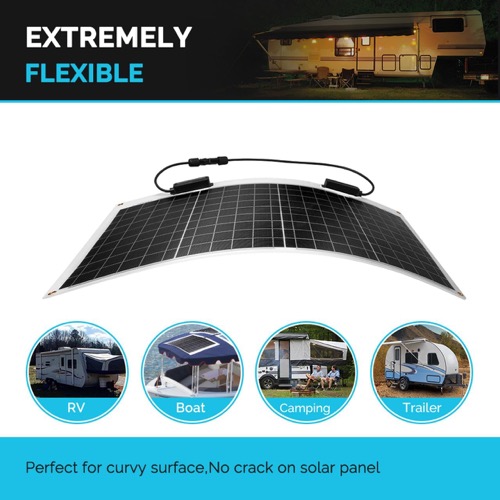
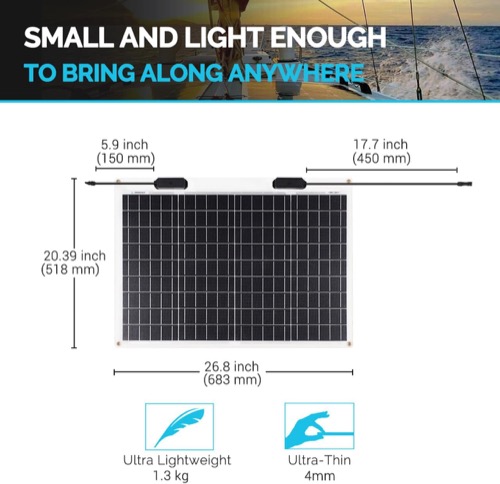
First thing owners notice is how little there is to it. At 2.87 pounds and roughly a tenth of an inch thick, this Renogy 50W flexible solar panel weighs about 70% less than a conventional 50W panel and sits about 95% thinner. Laid flat on a roof, it nearly vanishes — which is the whole point for stealth van and boat setups.
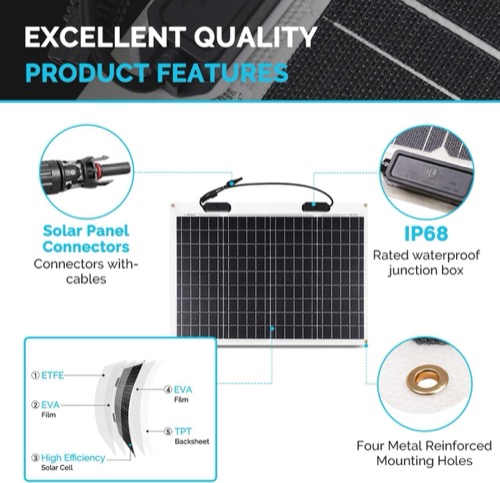
Underneath is a polymer laminate over monocrystalline cells, with no aluminum frame and no tempered glass. That’s what makes it bend up to a claimed 248 degrees. In practice, most owners describe it as a little stiffer than they expected — and a few actually like that, since a bit of rigidity keeps the panel from flapping in the wind on a cabin top.
Weak spots come down to the small parts. Owners note the eyelet grommets aren’t especially high quality and can work loose over months, and a couple report the MC4 connector or its housing failing after a while outdoors. There are also isolated reports of panels arriving burnt and discolored around the edges with messy caulk — a batch-quality thing worth checking the day yours shows up.
What 50 Watts Actually Delivers
Rated at 50W, the panel turns that into roughly 34W of real output in good sun, or about 136 Wh on a typical day with four solid peak sun hours. That’s enough to keep a 12V deep-cycle battery topped and cover light loads, but not enough to run a fridge on its own. One boat owner puts it plainly: steady power for navigation and LED lighting, not for the refrigerator.
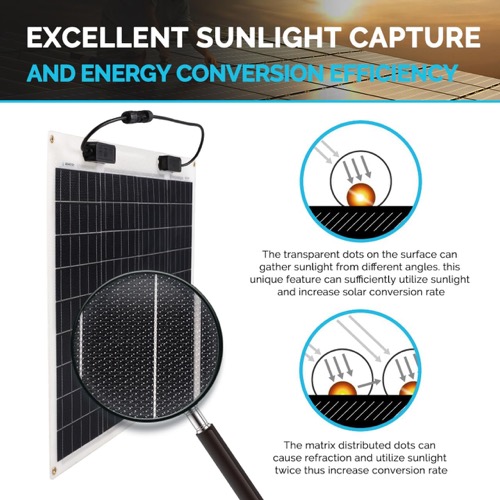
In practice, owners are impressed for the size. Several say it rivals rigid panels, and one measured about 20% more output than three other flexible 50W panels on a cloudy day. Another keeps a 12-volt lead-acid deep-cycle fully charged, and a third tops fish-finder and bait-tank batteries back up by afternoon after falling a little behind in the morning.
Cloudy weather slows it but doesn’t stop it. Expect output to sag to roughly 7 to 15W under heavy overcast — enough to keep a trickle going and hold ground, just not to fully charge from low. To be fair, that morning lag is real, so a single panel matches modest loads without much headroom when the sun is weak.
| Condition | Estimated Output | What That Means |
|---|---|---|
| Full sun, ideal angle | ~34 W | Keeps a 12V battery topped; ~136 Wh gained over the day |
| Partly cloudy sky | ~17 W | Still charging, just slower to fill the battery |
| Overcast / heavy clouds | ~7-15 W | Holds a trickle; prevents drain but won’t fully charge |
| Panel angle 45° off optimal | ~22-24 W | Minor hit; flat-laminate installs often land here |
| Winter / weak sun | ~18-22 W | Still useful; fewer peak sun hours overall |
| Panel partly shaded | ~5-10 W | Big drop; avoid shaded mounting spots |
Real-World Math — Using a 0.68 real-world factor, this 50W panel delivers roughly 34W in good sun. Stack up four hours of peak sun and you bank about 136 Wh. A 12V/50Ah battery holds around 600 Wh, and self-discharge plus light loads run well under 136 Wh a day — so this panel maintains charge with room to spare.
These are estimates. Your actual numbers depend on angle, sky, shade, temperature, and how long your cable run is.
Batteries and Gear It Keeps Topped Up
For a panel this size, the real question is “what can it actually keep charged?” The answer is 12V batteries and light DC loads. Owners run it on lead-acid, AGM, and deep-cycle batteries in boats, RVs, campers, and stored vehicles, and it pairs cleanly with 12V systems thanks to standard MC4 leads.
Here’s the catch, though: it outputs directly, so you supply the controller. To charge a battery safely you’ll add your own PWM or MPPT controller between the panel and the battery. Owners who do this report batteries maintained through winter storage and modest loads — a large Dometic fridge, a MaxxAir fan, and LED lights — kept running when the panel is part of a larger array.
| Battery / Load | Typical Use | Compatible? | Notes |
|---|---|---|---|
| Flooded lead-acid (12V) | Car, truck, marine | Compatible | Standard 12V maintenance; add a controller |
| AGM (sealed) | RV, boat, UPS | Compatible | Good for sealed bays; no gassing |
| Deep-cycle (12V) | Marine, RV house battery | Compatible | Owners report it kept fully charged |
| LiFePO4 (12V) | Van life, RV | Needs LFP mode on controller | Owners run Renogy LiFePO4 packs in parallel systems |
| Navigation / LED loads | Boat electronics | Compatible | Steady power reported for lights and nav |
| Refrigerator / inverter | RV, off-grid | Not recommended | 50W alone can’t run a fridge; add panels |
Buyer Heads-Up — There’s no charge controller in the box. For a 12V battery you’ll need to add a PWM or MPPT controller, and for LiFePO4 packs make sure that controller has a lithium charge profile. Charging lithium on a plain lead-acid setting can cut its life short.
Holding Up on Boats and Curved Roofs
There’s no certified IP rating listed for this panel, just the thin laminate construction and Renogy’s load ratings of 2400 Pa wind and 5400 Pa snow. That’s an important distinction — you’re trusting the lamination and your own sealing job, not a stamped waterproof spec.
Real-world durability leans positive, though. A sailboat owner reports two of these still looking great and putting out the same amps after a full year under the Florida sun, and others describe it as better built than competing flexible panels they’ve used on boats. The 5-year warranty backs the panel itself.
The honest caveats are the small parts and the batch lottery. Grommets loosen, the MC4 connector can fail after months of exposure, and a few owners received units that arrived discolored around the edges. Seal your connections well, bond the panel properly, and inspect it on arrival.
| Feature | This Panel | What It Means Outdoors |
|---|---|---|
| IP rating | None certified stated | Trust the laminate and your own sealing — not a rated spec |
| Frame / construction | Frameless polymer laminate | Ultra-thin and light; no frame to corrode, but no air gap either |
| Panel surface | Thin polymer lamination | Wipes clean; runs hotter than framed glass |
| Wind / snow load | 2400 Pa / 5400 Pa rated | Strong on paper for a thin panel |
| Connector weatherproofing | MC4, not sealed by default | Seal it — owners report connector failures over months |
| Long-term owner reports | Full year in Florida sun, same output | Solid for most; grommets and connectors are the weak points |
| Batch quality | Mostly good, some discolored units | Inspect on arrival; QC varies |
Worth Knowing — A frameless laminate panel sits flush against your surface, which looks clean but traps heat with no air gap underneath. Solar cells lose efficiency as they warm up, so mounting on a light-colored or ventilated surface helps output on hot days.
Sticking It to Curved Surfaces
Mounting is where a flexible panel is different from a rigid one, and it’s worth getting right. Corner grommets come built in, but Renogy is clear that those are for stationary use only — a fixed shed or cabin roof. For anything that moves, you’re meant to bond it with silicone structural adhesive on the back.
Owners get creative and it mostly works. Nano tape holds one to the front of a camper for winter storage, snaps secure others to a bimini top, and silicone bonds them to van roofs and rounded generator covers. Just remember the panel is stiffer than the photos imply — measure your curve first, since one buyer couldn’t get it to conform to a tight trailer bend and returned it.
Wiring is the other thing to plan for. The MC4 leads run only about a foot long, and there are no extension cables or controller in the box. You’ll almost certainly need MC4 extensions to reach from the mounting spot to your controller and battery.
Practical Tip — Buy MC4 extension cables in the length you need at the same time as the panel, and keep the connector type MC4 end to end. The stock leads are too short for nearly any real install, and matching connectors avoids the voltage drop and corrosion that come with cheap adapters.
The 5-Year Warranty and Safety Picture
There are no specific safety certifications listed for this panel beyond Renogy’s own ratings, so you’re leaning on the brand’s reputation and the 5-year warranty. For a low-wattage 12V maintenance panel, the stakes are modest, but the controller you add is what actually protects your battery — so choose a reputable one with overcharge and reverse-current protection.
Warranty coverage is a genuine strength here. Five years is generous for a flexible panel, and it’s backed by an established brand rather than a rotating no-name seller. Owners who hit problems — discolored units, for instance — report that returns get handled, which matters when batch quality varies.
On safety incidents, the feedback is reassuring. There’s no pattern of melting or smoke; the reported issues are cosmetic or connector-related, like a plug that split apart during handling. Bond the panel properly, seal the MC4 connections, and the main risk is a loose grommet, not a hazard.
Long-Term Ownership — Monocrystalline cells degrade slowly, and an owner’s full year of Florida sun with no output loss backs that up. On a flexible panel, the real weak points are the connector, the grommets, and the adhesive bond — not the cells. Seal the connections and check the mount each season and this panel should outlast several batteries.
Where This Little Flexible Panel Fits — Use-Case Fit Matrix
| Use Case | Fit | Why |
|---|---|---|
| Boat / marine 12V battery maintenance | Strong fit | Thin, light, proven over a year in marine sun |
| Curved surface (bimini, van roof, gen cover) | Strong fit | Bends to gentle curves where rigid panels can’t go |
| RV / camper battery trickle charge | Strong fit | Keeps a 12V house battery topped in storage |
| Stored vehicle battery over winter | Strong fit | Offsets self-discharge; owners maintain packs all season |
| Weight-sensitive or stealth install | Strong fit | Under 3 lb and a tenth of an inch thick |
| Light DC loads (nav, LED lights, fish finder) | Solid fit | 50W covers modest loads with headroom |
| Expandable multi-panel 12V array | Solid fit | MC4 leads make parallel wiring easy |
| LiFePO4 battery charging | With caveats | Needs a controller with a lithium profile |
| Tight or sharp curved surface | Borderline | Stiffer than photos suggest; measure first |
| Running a fridge or inverter alone | Not recommended | 50W is maintenance-class, not a power source |
| Permanent mount without adhesive | Skip | Grommets are stationary-only; bond it for mobile use |
| Full-shade mounting location | Skip | Output collapses in shade; defeats the purpose |
Grab it if you want:
- A thin, light panel that disappears on a boat, van, or curved roof
- Something to keep a stored 12V battery full through the off-season
- Rigid-panel-class output in a package that bends onto gentle curves
- An easy building block you can wire in parallel with more panels later
Pass on it if you need:
- Enough power to run a fridge or inverter from one panel
- A panel that bends onto a tight or sharply curved surface
- A plug-and-play kit with a controller and cables in the box
- A certified IP rating stamped on the spec sheet
This is a different tool for a different job — not underpowered, just built for maintenance and tight spots, not heavy loads.
Is 50 Flexible Watts Enough?
For most buyers, this Renogy 50W Flexible Solar Panel review lands in a practical place: it’s the pick when your mounting spot is curved, weight matters, or a rigid glass panel simply won’t fit. Owners praise its output for the size, it holds up over a year of hard marine sun, and the 5-year warranty from an established brand is real peace of mind. Those are genuine wins for a maintenance-class panel.
The trade-offs are just as clear. It’s stiffer than the photos suggest, the leads are short, there’s no controller in the box, and 50 watts won’t run a fridge. So here’s the if/then: if you want a thin, light panel to keep a 12V battery topped on a boat, van, or stored vehicle — and you’ll add a controller and extension cables — this Renogy flexible solar panel is an easy recommendation. If you need real capacity or a tight bend, size up or look at a rigid panel instead.
Pros & Cons Analysis
Based on extensive testing and Amazon customer feedback
Pros
- Genuinely thin and light — at 2.87 pounds and roughly a tenth of an inch thick, owners describe it as barely noticeable once mounted. Buyers pick it specifically because it disappears on a boat cabin top or a van roof where a rigid glass panel would be a problem.
- Output that holds its own — owners report it rivals rigid panels and keeps a 12-volt lead-acid deep-cycle battery fully charged. One buyer measured about 20% more output than three other flexible 50W panels on a cloudy day.
- Handles curved and uneven surfaces — the semi-flexible build lets it sit on a rounded generator cover or a bimini top where flat panels can't go. Owners mount it with nano tape, snaps, or silicone and it conforms to gentle curves.
- Proven in the sun over a full year — a sailboat owner reports the panels still look great and put out the same amps after a full year under the Florida sun. Several describe it as durable and better built than other flexible panels they've used on boats.
- Easy to wire and expand — the MC4 leads make it simple to add to a 12V DC system, and one owner runs two of these alongside a 100W panel wired parallel for about 175W at peak. Two 50W units gave another buyer roughly 6 more amps.
- A little stiffness can be a feature — one boat owner mounted it on a cabin top and liked that being slightly stiff kept it from flapping in the wind. For flat and gently curved installs, that rigidity adds security.
- Reliable for battery maintenance — attach it to a charge controller and owners report a battery held full through winter storage, plus fish finders and bait-tank batteries topped back up by afternoon. It quietly does the set-and-forget job.
- Built to shrug off wind and snow — Renogy rates it for wind up to 2400 Pa and snow loads up to 5400 Pa, and the 5-year warranty backs it up. For a thin laminate panel, that's a reassuring spec on paper.
Cons
- Less bendable than the photos suggest — the most common gripe is that it's stiffer than expected. One buyer couldn't flex it enough to fit a trailer curve and sent it back, and another says they'd never bend it the way the listing shows.
- Eyelet rivets and connectors can loosen — a recurring note is that the mounting grommets aren't high quality and work loose over time, and one owner had a plug split apart in their hand while adding dielectric grease.
- 50W is a maintenance-class output — one boat owner notes it puts out steady power for navigation and LED lighting but isn't suitable for running a fridge on its own. This is a trickle-and-top-up panel, not a whole-rig power source.
- Quality control isn't perfect — a couple of owners received panels that arrived burnt and discolored around the edges with caulk applied messy and inconsistent. It's the kind of batch variance that means you should inspect yours on arrival.
- Short leads, no controller or cables in the box — the pigtail cables run about a foot long, and owners point out that a charge controller and extension cables aren't included. You'll be buying wiring and a controller separately.
- Grommets are for stationary use only — Renogy states the eyelets are only for non-mobile applications and the panel should be bonded with silicone structural adhesive for anything that moves. Skip that step and the mount can fail on the road or water.
- Connector failures show up over months — separate from the loose rivets, a few owners report the MC4 or its housing failing after several months of outdoor exposure. On a low-wattage panel, connector quality is the real long-term weak point.
- Early in the day it can fall behind — one owner notes it lags in the morning before catching batteries back up by afternoon. A single 50W panel matches modest loads but has little headroom when the sun is weak.
Is 50 Flexible Watts Enough?
For most buyers, this Renogy 50W Flexible Solar Panel review lands in a practical place: it's the pick when your mounting spot is curved, weight matters, or a rigid glass panel simply won't fit. Owners praise its output for the size, it holds up over a year of hard marine sun, and the 5-year warranty from an established brand is real peace of mind. Those are genuine wins for a maintenance-class panel.
The trade-offs are just as clear. It's stiffer than the photos suggest, the leads are short, there's no controller in the box, and 50 watts won't run a fridge. So here's the if/then: if you want a thin, light panel to keep a 12V battery topped on a boat, van, or stored vehicle — and you'll add a controller and extension cables — this Renogy flexible solar panel is an easy recommendation. If you need real capacity or a tight bend, size up or look at a rigid panel instead.
Frequently Asked Questions
How flexible is the Renogy 50W panel really?
It bends, but less than the marketing photos suggest. Renogy rates it to flex up to 248 degrees, yet owners consistently describe it as stiffer than expected and warn against bending it as dramatically as the listing shows. It handles gentle curves like a bimini top, a rounded generator cover, or a van roof well, but one buyer couldn't get it to conform to a tight trailer curve and returned it. For anything with a sharp bend, measure your curve first.
Will this 50W panel keep my 12V battery charged?
For maintenance and light loads, yes. Owners report it keeps a 12-volt lead-acid deep-cycle battery fully charged and holds a battery through winter storage when paired with a charge controller. In good sun it delivers roughly 34W of real output, or about 136 Wh across a typical four-hour peak-sun day. That is plenty to offset self-discharge and run modest loads like LED lights or a fish finder, but it is not enough to run a fridge on its own.
Does it come with a charge controller or cables?
No. The panel ships with short MC4 pigtail leads about a foot long, and owners point out that a charge controller and any extension cables are not included. To charge a 12V battery you need to add your own PWM or MPPT controller plus MC4 extension cables to reach from the panel to the battery. Budget for both before your install so you are not stuck partway through.
Can I wire two of these together for more power?
Yes. The MC4 leads make it easy to expand, and owners regularly pair units in a 12V DC system. One buyer runs two 50W panels alongside a 100W panel wired in parallel for about 175W at peak, and another gained roughly 6 more amps from adding two. For 12V systems, parallel wiring with a Y-branch connector keeps the voltage steady while adding current.
How do I mount a flexible panel like this?
For anything that moves, bond it. Renogy states the eyelet grommets are only for stationary applications and that mobile installs should use silicone structural adhesive on the back of the panel. Owners have had success with nano tape, snaps, and adhesive on boats, campers, and generator covers. The grommets do work for a fixed shed or cabin roof, though a few owners note they can loosen over time, so adhesive is the more secure long-term choice.
Is it durable enough to leave outside year-round?
Owner feedback is mostly positive. A sailboat owner reports two of these still looking great and putting out the same amps after a full year under the Florida sun, and Renogy rates the panel for 2400 Pa wind and 5400 Pa snow loads with a 5-year warranty. That said, a small number of buyers received panels that arrived discolored, and the MC4 connector and grommets are the parts most likely to give trouble over months of exposure. Inspect yours when it arrives and seal the connections well.
Does it charge on cloudy days?
It keeps producing, just at a reduced rate. One owner measured about 20% more output than three competing flexible 50W panels on a cloudy day, so it holds up relatively well in weak light. Expect output to drop to roughly 7 to 15W under heavy overcast, which slows charging but keeps a trickle going. Another owner notes it can fall behind early in the morning and then catch the batteries back up by afternoon.
What connector does it use and can I extend the cable?
It uses standard MC4 connectors, the most common solar connector, so extensions and adapters are easy to find. The stock leads are only about a foot long, so most installs need MC4 extension cables to reach the charge controller and battery. Keep the same MC4 connector type end to end to avoid the voltage drop and corrosion risk that come with cheap adapters.
Is 50W enough for my setup, or should I go bigger?
Think of 50W as a maintenance panel. It shines for keeping a stored car, boat, RV, or motorcycle battery topped off, and for light loads like navigation electronics, LED lighting, or a trail camera. If you want to run a refrigerator, inverter, or larger appliances, you will need more panels or a higher-wattage system. Owners who need real capacity add a second or third panel and wire them in parallel.
Technical Specifications
| Brand | Renogy |
|---|---|
| Model / SKU | RNG-50DB-H (ASIN: B07BMQRNXZ) |
| Product type | Ultra-flexible monocrystalline solar panel — for 12V battery maintenance and curved-surface off-grid charging |
| Solar cell type | Monocrystalline silicon |
| Maximum power output | 50 W |
| Open-circuit voltage (Voc) | Not specified |
| Maximum operating voltage (Vmp) | Not specified (~18 V typical for a 12V nominal panel) |
| Output voltage | 12 V (DC) |
| Maximum current (Imp) | 2.75 A (listed amperage capacity) |
| Short-circuit current (Isc) | Not specified |
| Cell efficiency | 22% (high-tier monocrystalline) |
| Charge controller included | No — direct MC4 output; pair with your own PWM or MPPT controller |
| Controller features | N/A (no controller in the box) |
| Connector type | MC4 |
| Cable length | About 1 ft leads (owners report short pigtails — MC4 extension commonly added) |
| Waterproof rating | No certified IP rating stated (thin polymer laminate; owners report a year of outdoor marine use) |
| Operating temperature range | Not specified |
| Dimensions (L × W × H) | 28.03" × 18.11" × 0.16" |
| Weight | 3 lb (2.87 lb per manufacturer description) |
| Frame material | Frameless (advanced polymer laminate — no aluminum frame) |
| Surface / glass material | Thin polymer lamination over monocrystalline cells (no tempered glass) |
| Mounting type | Corner grommets (stationary use only) + silicone structural adhesive for mobile installs |
| Compatible devices / batteries | 12V batteries (lead-acid, AGM, deep-cycle, LiFePO4) with an added charge controller; marine, RV, van, and cabin 12V systems |
| Required sunlight hours | 4 peak sun hours/day delivers ~136 Wh (estimated at 0.68 real-world factor) |
| Wind / snow load rating | 2400 Pa wind / 5400 Pa snow |
| Safety certifications | Not specified |
| Special features | Flexes up to 248°; about 95% thinner and 70% lighter than a rigid 50W panel; ultra-thin stealth profile for curved surfaces |
| Included in the box | 1× 50W flexible solar panel (no charge controller, cables, or mounting hardware included) |
| Warranty | 5 years |
| Expected lifespan | Not specified (owner reports full-year marine use with no output loss) |
| Unit count | 1 |
| Best for | Maintaining 12V marine, RV, and stored vehicle batteries on curved or weight-sensitive surfaces; light off-grid loads like navigation electronics and LED lighting |