If you’re trying to pin down the best portable solar panels, the honest answer comes down to three things: how many watts you actually need, what you’re plugging into, and which form factor fits how you’ll carry and store it. Get those three right and the rest is detail. Get one wrong and you end up with a panel that won’t connect, won’t move easily, or won’t deliver the watts on the box. Here’s the thing — most buyers fixate on the wattage number and skip the other two entirely.
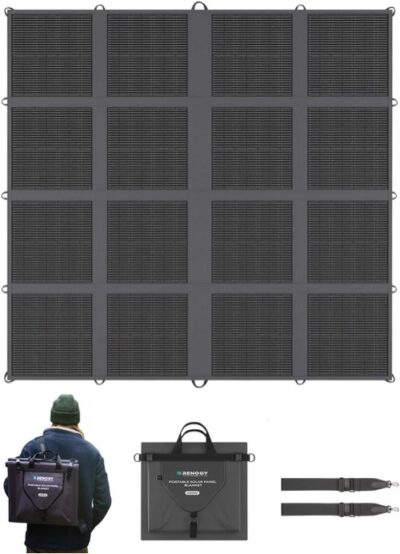
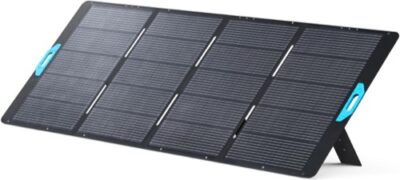
The problem isn’t a shortage of panels — it’s that “portable” covers wildly different things. A 100W foldable briefcase at 9.5 lb, a 400W roll-up blanket, and a rigid bifacial panel all get called portable, but they behave nothing alike in weight, durability, and output. In practice, the wrong choice shows up as a panel that won’t plug into your power station, one that’s too heavy to actually move, or rated watts you never see in real sun. That last one catches almost everyone.
This guide compares eight portable solar panels across every form factor and wattage tier — 100W to 400W, roughly 9.5 lb to 22 lb, foldable to blanket to rigid. We focus on what matters in real use: real-world output vs rated watts, connector compatibility, weatherproofing, and weight-per-watt. The right pick depends on what you’re powering and how you’ll handle the panel, so the best portable solar panels for an RV owner aren’t the same as the best ones for a power-station charger. Match the panel to the job and you won’t overpay or under-buy.
Not Sure How Many Watts You Need?
Our Solar Panel Output Calculator estimates how much energy a portable panel produces per day based on your location’s sun hours — and tells you whether that’s enough to charge your power station, support an RV battery, or run your essential loads off-grid.
Use the Solar Calculator — Jump to the Form Factor Guide
How We Chose the Best Portable Solar Panels
We didn’t run these panels through a lab, and we won’t pretend otherwise. Instead, we weighed manufacturer specs against owner feedback patterns and looked at how each panel fits its brand’s lineup. The criteria that matter span every form factor: real-world output vs rated watts, connector compatibility with common power stations, weight-per-watt, weatherproofing, and value measured as cost-per-watt. To be fair, no single panel wins on all of them — the budget pick trades weight for price, the blanket trades rigidity for packability. Honestly, the right call depends on the job, which is why the lineup spans 100W foldables to a 400W blanket and a rigid bifacial brand panel.
| Criterion | Why It Matters for Portable Solar | Weight |
|---|---|---|
| Real-world output (vs rated watts) | Rated watts come from lab conditions; cell type and controller decide what you actually get in real sun | High |
| Connector compatibility | MC4, XT60, and brand DC plugs are not interchangeable — the wrong one means an adapter or no charging at all | High |
| Weight-per-watt and form factor | A panel you can’t move easily won’t get used; blanket, foldable, and rigid each trade weight for durability | High |
| IP weatherproofing rating | Portable panels live outdoors; IP65 minimum, IP67/68 for exposed or long-term setups | Medium |
| Charge controller / power-station fit | Power stations have built-in MPPT; bare 12V or LiFePO4 batteries need a separate controller | Medium |
| Value (cost-per-watt) | Price per watt matters, but only after weatherproofing, connector, and cell quality are accounted for | Medium |
| Warranty and brand support | Longer warranty signals confidence for a product that lives outdoors — ranges from 1 year to 12 years here | Low |
Selection criteria:
- Real-world output — N-Type monocrystalline (~25%) and bifacial panels outperform standard mono in low light; apply a real-world factor, not the nameplate watt
- Connector compatibility — native or included cables for MC4, XT60, and brand DC plugs (EcoFlow, Jackery, Bluetti, Anker)
- Weight and form factor — foldable, blanket, and rigid trade portability against durability and output per square inch
- IP rating — IP65 minimum; IP67/68 for exposed or long-term outdoor use
- Charge controller fit — power stations handle MPPT internally; bare battery setups need a separate controller
- Cell type — N-Type, bifacial, or standard mono with ETFE coating
- Value — cost-per-watt compared against weatherproofing, connector ecosystem, and cell quality
- Warranty — ranges from 1-2 years (GRECELL, ECO-WORTHY) to 12 years (Renogy 400W Blanket)
Form Factor Guide: Foldable vs Solar Blanket vs Rigid
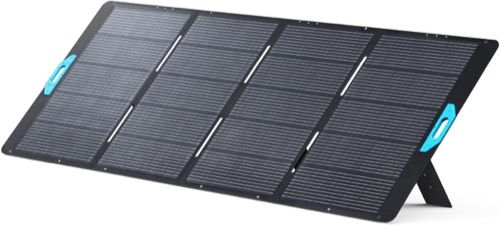
“Portable” is one word for three very different shapes. Foldable briefcase panels are the default — durable frames, kickstands, easy to prop up. Roll-up solar blankets trade rigidity for the lowest packed footprint and weight-per-watt. Rigid bifacial panels capture reflected light and run cooler, but they’re the heaviest and least packable. Match the form factor to how you’ll carry, mount, and store the panel — not just to wattage.
| Form Factor | Panels in This Lineup | Weight / Portability | Durability | Output Notes | Best For |
|---|---|---|---|---|---|
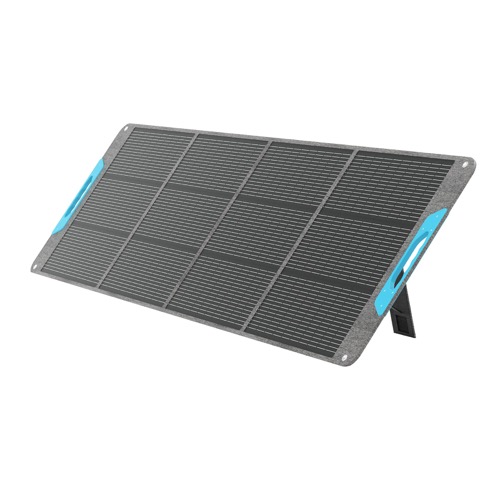
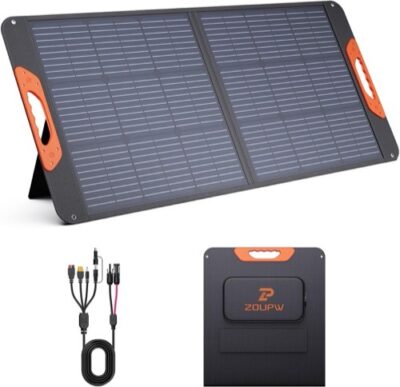
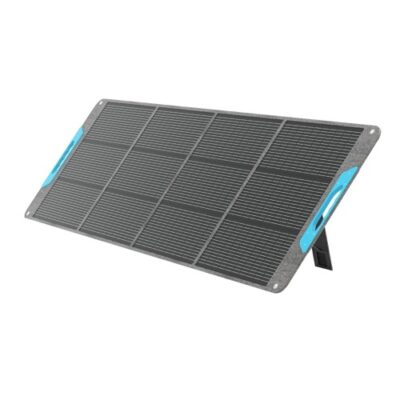
| Foldable briefcase | Renogy 200W, BougeRV 200W, ZOUPW 100W, Jackery SolarSaga 200W, GRECELL 100W, ECO-WORTHY 200W | ~9.5 to 22 lb; kickstands prop the panel at a usable angle, then fold flat to carry | Framed panels are sturdy, though hinges and latches wear over years of folding | Standard mono to bifacial; the bifacial models recover a little extra from reflected light | General power-station and 12V charging where you set up and take down often |
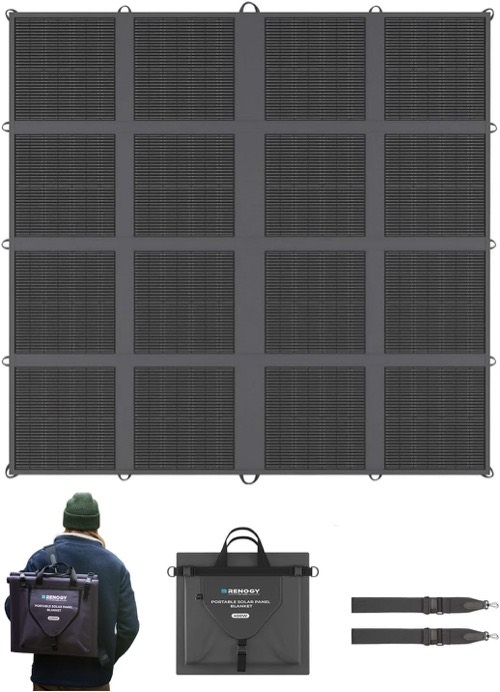
| Solar blanket (roll-up) | Renogy 400W Portable Solar Panel Blanket | Lowest weight-per-watt here — ~16 lb for 400W and the smallest packed footprint | No rigid frame; fabric backing flexes well but creasing the cells over time is the risk | 400W in a packable form, but lays flat, so you lose some angle optimization | High-capacity charging where packed size and weight-per-watt matter most |
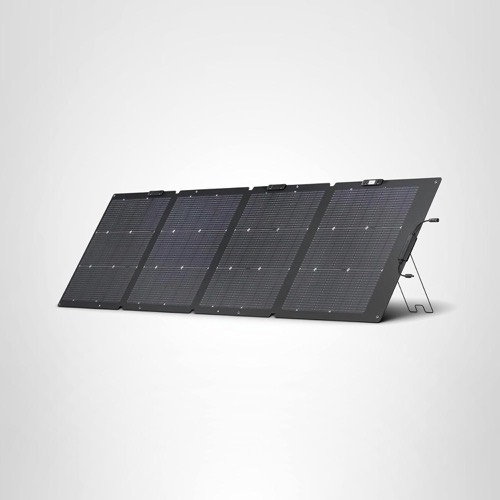
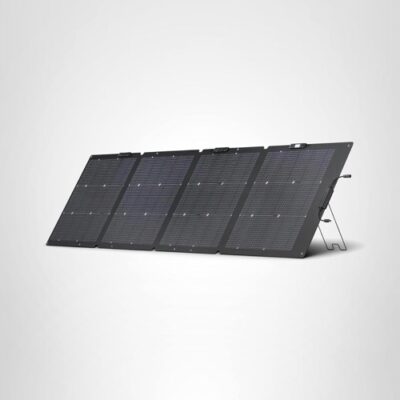
| Rigid bifacial | EF ECOFLOW 220W | Heaviest and least packable at ~15.4 lb — a rigid panel, not a fold-and-stash design | Most durable surface; bifacial glass/ETFE construction handles weather well | Bifacial captures reflected light, runs cooler, and posts the highest real-world output here | Fixed or semi-permanent high-output setups where weight is less of a concern |
Worth Knowing — Weight does not scale neatly with wattage across form factors. The Renogy 400W Blanket weighs about 16 lb for 400W, while the ECO-WORTHY 200W foldable runs around 22 lb for half the wattage. If weight-per-watt is your priority, the form factor matters more than the rated watt number.
How to Choose a Portable Solar Panel
Before you buy, run through this short list. It’s the fastest way to avoid the two most common regrets — a connector that won’t fit and a panel too heavy to use.
What to prioritize in a portable solar panel:
- Real-world output, not just the rated watt number — check the cell type
- The correct connector for your power station or battery — verify before buying
- Weight-per-watt that matches how often you’ll actually move the panel
- IP65 or higher weatherproofing (certified, not just “waterproof claimed”)
- A kickstand or mounting hardware that holds the panel at a usable angle
Common buyer mistakes:
- Buying on rated watts alone without checking the real-world factor or cell type
- Ignoring the connector — MC4, XT60, and brand DC plugs are not interchangeable
- Choosing a heavy 200W panel when a lighter form factor would cover the same load
- Wiring a panel straight to a bare 12V battery with no charge controller
Wattage: Matching Panel to Need
Start with the load you’re actually covering, then add a little headroom — don’t size off the box. The lineup spans three practical tiers. A 100W panel (ZOUPW, GRECELL) tops a small-to-mid power station or supports an RV battery; 200W (Renogy, BougeRV, Jackery, EcoFlow, ECO-WORTHY) covers a 1kWh-class station or off-grid essentials; and 400W (Renogy Blanket) handles high-capacity charging or multi-day off-grid loads. For more on translating watts into real energy, see our guide on how much power a solar panel produces and the 100W vs 200W comparison. The takeaway is simple — round up modestly, not aggressively.
Real-World Math — A 200W panel at 4 peak sun hours and an 0.82 real-world factor delivers roughly 656 Wh/day — enough to recover a 500Wh power station in under a day, or to cover a small off-grid load of lights, a router, and a couple of device charges with headroom.
Real-World Output vs Rated Watts
The rated watt is a Standard Test Conditions number — 25°C, 1,000 W/m², no angle loss. Real output runs lower, every time. As a rough guide, N-Type or bifacial mono into a power station’s built-in MPPT lands around 0.80-0.82; standard mono with MPPT around 0.78; a basic PWM controller closer to 0.68. On the flip side, bifacial panels like the BougeRV, Jackery, and EcoFlow can claw back a bit of output from light reflected off bright ground. The takeaway — always calculate with the real-world factor, not the nameplate.
Form Factor & Portability
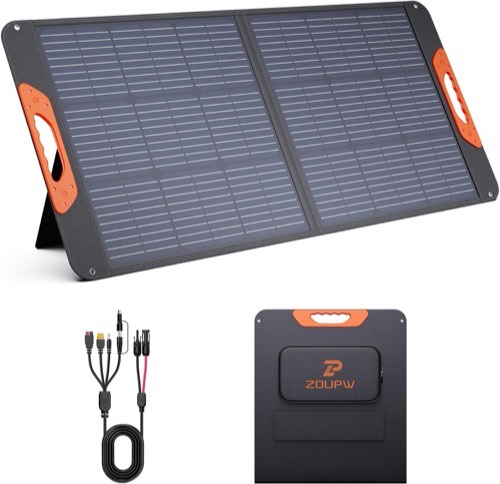
The weight spectrum in this lineup is wide. The ZOUPW 100W at ~9.5 lb is the lightest; the Renogy 400W Blanket packs the most watts per pound at ~16 lb for 400W; and the ECO-WORTHY 200W at ~22 lb is the heaviest absolute. Foldables prop up on kickstands, blankets lay flatter and pack smaller, and rigid bifacial panels are the most durable but least packable. Worth knowing — pick the form factor for how you store and move it, then check wattage.
Pro Tip — If you’ll move the panel often or store it in a vehicle, weigh the packed size and weight as heavily as the watt rating. A 400W blanket that rolls up beats a 22 lb rigid panel for anyone who relocates the array regularly — even though both are sold as “portable.”
Connectors & Power Station Compatibility
This is where buyers get caught. Most panels here output MC4 and/or XT60 (Renogy, EcoFlow, ECO-WORTHY, GRECELL, Renogy Blanket), while Jackery uses DC8020/DC7909 and BougeRV ships DC7909/DC5521 plus adapters. On the power-station side, EcoFlow uses XT60/XT60i, Jackery uses DC8020/DC7909, Bluetti uses T500 or aviation connectors, and Anker SOLIX uses XT60. The catch is voltage — confirm the panel’s Vmp falls inside your station’s solar input range and below its input ceiling. For brand-specific matching, our portable panel for power station guide and the EcoFlow vs Jackery comparison go deeper.
Buying Note — A panel with native MC4 output is the most flexible — it works with most solar charge controllers and, with a cheap MC4-to-brand adapter, most power stations. A panel locked to a single brand’s DC plug (like the Jackery SolarSaga’s DC8020) is simplest for that brand’s owners but needs an adapter for anything else.
Weatherproofing (IP Ratings)
IP ratings are simpler than they look. IP65 handles rain and spray from any direction (Renogy 200W, ECO-WORTHY); IP67 adds brief submersion resistance (ZOUPW); IP68 is the most weatherproof (Jackery SolarSaga, EcoFlow 220W). The honest caveat — the panel surface and the junction box or controller module can carry different ratings, so verify which part is actually rated. In practice, IP65 is fine for sheltered or stowed-between-showers use, while IP67/68 is the safer pick for panels left out long-term.
Charge Controllers (When You Need One)
Keep this one simple, and see the dedicated section below for the full breakdown. Charging a power station needs no separate controller — the station’s built-in MPPT handles it. Charging a bare 12V lead-acid, AGM, or LiFePO4 battery directly does need one, and for LiFePO4 you want an MPPT controller with an LFP charge profile. Our MPPT vs PWM guide covers the difference. The takeaway — power station owners can skip the controller; battery-bank owners can’t.
What Can These Solar Panels Do?
Watts and watt-hours stay abstract until you put real loads next to them. At 4 peak sun hours — a reasonable average across much of the US and Europe — here’s what each wattage tier in this lineup actually delivers, and where you’ll want more panel than the label suggests.
| Panel Size | Est. Daily Output (4 PSH) | Best Suited For | Watch Out |
|---|---|---|---|
| 100W | ~328 Wh/day | Topping a 300-500Wh power station; 12V battery support; device charging | Won’t fully recover a 1kWh station in one day |
| 200W | ~656 Wh/day | 1kWh-class power station; RV house battery; off-grid essentials | Heavier foldables (~22 lb) get left behind if you move often |
| 220W | ~722 Wh/day | High-output brand setups; fixed or semi-permanent installs | Rigid bifacial is the least packable form factor here |
| 400W | ~1,312 Wh/day | High-capacity charging; multi-day off-grid loads; large power stations | Blanket lays flat, so angle losses cut into peak output |
Output estimates use a 0.82 real-world factor (monocrystalline into a power-station MPPT) and 4 peak sun hours. Actual output varies with sun angle, weather, shading, temperature, cable length, and controller type.
Cloudy days hurt more than you’d expect. A 100W panel in full overcast can drop to 15-30W of actual output — enough to slow a power station’s drain but not fully recover it. For locations with frequent cloud cover, size up a tier or plan a wall-outlet top-off.
Portable Solar Panel Wattage Guide
- Under 100W: Phone, tablet, and small-device charging; trickle support for a 12V battery; topping a compact power station on a sunny day
- 100W: The entry sweet spot — fully recharges a 300-500Wh power station in an afternoon; manageable weight around 9-10 lb
- 150W–200W: Charges a 1kWh-class power station, supports RV house batteries, and covers off-grid essentials; expect ~14-22 lb depending on form factor
- 220W (rigid bifacial): Highest single-panel output here; best for fixed or semi-permanent high-output setups where weight is less of a concern
- 400W (blanket): High-capacity portable charging and multi-day off-grid loads; the best weight-per-watt in this lineup at ~16 lb
Do You Need a Charge Controller?
Most portable solar panels output 18-34V DC through their main connector, which falls inside the 11-60V solar input range of most EcoFlow, Jackery, Bluetti, and Anker power stations. Those stations have a built-in MPPT charge controller, so you don’t need to buy a separate one to charge them. You do need a controller if you’re charging a standalone 12V lead-acid, AGM, or LiFePO4 battery directly — without one, the panel can overcharge the battery or backfeed current at night.
| Charging Scenario | Separate Controller Needed? | Why |
|---|---|---|
| Panel → EcoFlow / Jackery / Bluetti / Anker power station | No | The station has built-in MPPT; just connect the right cable |
| Panel → Standalone 12V AGM or lead-acid battery | Yes — PWM or MPPT | No overcharge or anti-drain protection without a controller |
| Panel → LiFePO4 battery (RV, van, DIY bank) | Yes — MPPT with LFP mode | LiFePO4 needs a specific charge profile; the wrong one shortens battery life |
| Panel → Phone / tablet via built-in USB output | No | USB output is already regulated; plug the cable in directly |
| 50W+ panel → 12V battery in variable light | MPPT recommended | MPPT extracts ~10-30% more than PWM in partly cloudy or low-angle sun |
Worth Knowing — Wire a panel straight to a 12V battery with no controller and it can backfeed current overnight, slowly draining the battery you were trying to keep charged. Every bare-battery setup needs a controller with anti-drain protection. Power stations handle this automatically — no extra hardware.