GRECELL SP-100 Review: A Budget 100W Folding Panel That Punches Above Its Price
At a Glance
KEY FEATURES
- Power output: 100 W (rated), monocrystalline silicon with ETFE lamination
- Output: 20V DC, up to 5A (connector rated to 25A max) — no onboard USB output
- Cell efficiency: up to 23.5% (manufacturer-stated monocrystalline)
- Weatherproofing: Durable Oxford cloth with ETFE lamination — dust and high-temperature resistant; no certified IP rating, water-resistant only
- Charge controller: None — direct DC output meant to feed a power station's input or a separate MPPT controller
- Best for: Camping, RV and van life, off-grid backup, and emergency power-station charging on a budget
PROS
- Strong value — owners report 80-90W in good sun from a budget-priced 100W panel
- Briefcase fold, built-in kickstands, zippered cable pocket — true grab-and-go
- MC4 + DC adapters + Anderson cable — works with most major power stations
- Monocrystalline cells, decent cloudy-day output, expandable in series/parallel
- Lightweight (~10 lbs) and excellent, responsive customer service
CONS
- No certified IP rating — water-resistant only; keep ports out of rain
- Kickstands feel flimsy and finicky to deploy
- Some adapter fit misses (Jackery 300/1000); newer USB-C Jackerys need an adapter
- Heat throttling in hot climates; output can drop above ~85°F
- Unit-to-unit QC variability and thinner brand/warranty backing
Editor's Choice
Based on rigorous testing & Amazon customer feedback
☀ Solar Panel Output Calculator
Estimate how much energy the GRECELL SP-100 produces — and what it can power or charge.
Solar Setup
Portable devices
Power stations & batteries
Click devices to add them to your load list, adjust hours and quantity, then calculate.
Portable / Camping
Home Appliances
No devices added yet. Click chips above or add a custom device.
How many back-to-back sunless days should the battery keep you running? Example: 1 = one cloudy day, 3 = three cloudy days in a row.
This GRECELL SP-100 review starts with the number that hooks most buyers: owners report charging their power stations at 80-90W in good sun from this budget-brand 100W panel — output that rivals folding panels costing twice as much. One buyer measured 86W at peak day even with small clouds drifting through. That’s the value story in a nutshell.
Here’s the moment a lot of people land on this panel. You want reliable power-station charging for camping or backup, but the big names — Jackery, Anker, EcoFlow — ask a steep price for a single 100W folding panel. The honest question is whether a lesser-known brand can deliver comparable real-world watts without falling apart after one season outdoors.
To be fair, the budget badge does come with trade-offs. There’s no certified IP rating, brand recognition and warranty backing are thinner than the big names, and quality can vary unit to unit. But if you care most about output-per-dollar and you don’t plan to leave a panel out in the rain, the SP-100 makes a genuinely strong case.
At a Glance
| Spec | Value |
|---|---|
| Max Power Output | 100 W (monocrystalline) |
| Output Voltage | 20 V DC |
| Connector | MC4 + DC adapters + Anderson |
| Cell Efficiency | Up to 23.5% (manufacturer-stated) |
| Weatherproof Rating | Claimed water-resistant — no IP cert |
| Charge Controller | None — direct (feeds station input or external MPPT) |
| Cable Length | Not specified (owners add 20-50 ft) |
| Mount Type | Built-in kickstands + grommets |
| Best For | Budget power-station charging for camping, RV, and backup |
GRECELL SP-100 Review Summary
If you want strong power-station charging on a budget for camping, van life, or storm backup, the GRECELL SP-100 does what you’d expect — and then some. In practice, it’s putting out 80-90W in good sun, it folds into a self-contained briefcase with a zippered cable pocket, and the included MC4 plus adapter set plugs into most major power stations without a second purchase. Just know going in: there’s no certified waterproof rating and the kickstands feel a bit flimsy — so plan to bring it in when it rains and expect to fiddle with the legs a little during setup.
Folding Build and Portability
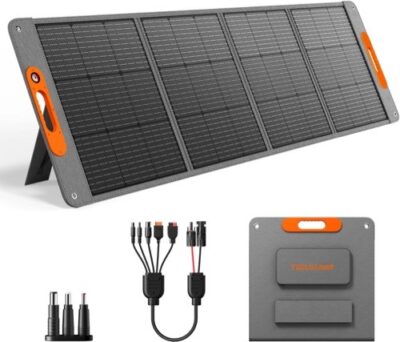
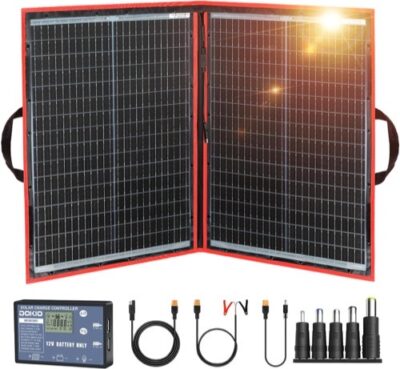
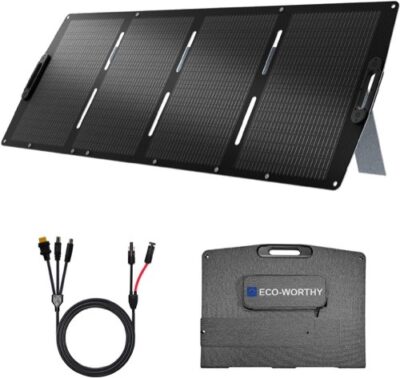
First impression for most owners: it’s well made and feels more solid than the price suggests. The panel folds in half and is held shut by strong magnets or snap straps, with a rigid carry handle across the top. Several buyers describe it as “self-contained” — cables, adapters, and even a spare extension all tuck into the built-in zippered pouch on the back.
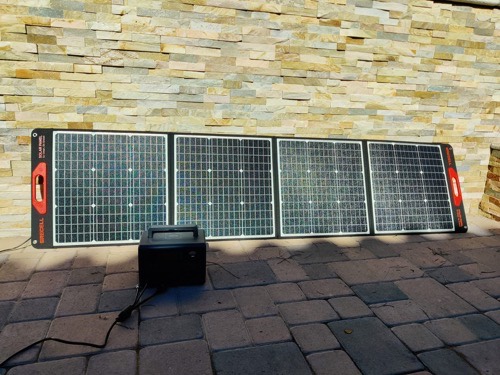
The cells sit under ETFE lamination on a durable Oxford cloth backing. That’s a fabric-style folding panel, not a rigid aluminum-framed unit — so it’s lighter and easier to reposition, though it also means you should keep items off the surface and watch the exposed back when laying it flat on a vehicle. At about 10 pounds for the 100W, owners with bad backs specifically picked it for how easy it is to spread out and re-aim through the day.
The weak spot is the kickstands. Here’s the thing — they work and hold a good angle, but the most common gripe across feedback is that they’re finicky to fold out (strong velcro), can fold back in when you lift the panel, and aren’t as stiff as some owners would like. Legs that locked in an open position would solve it.
Worth Knowing — The reinforced grommets aren’t just decoration. Owners hang the panel off an RV, tent, or roof rack with them, which is often a steadier setup than fighting the kickstands on uneven ground.
Charging Output and Efficiency
The SP-100 is rated at 100W — which in good sun translates to roughly 82W of real output, or about 328 Wh on a typical 4-peak-sun-hour day. That tracks closely with what owners actually see: 84-86W on clear days, with one careful side-by-side test putting the GRECELL at 84W against a Jackery SolarSaga 100’s 72W in the same conditions.
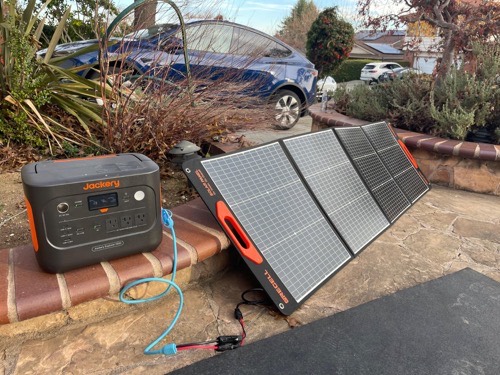
What does that mean in practice? Enough to meaningfully recharge a 500-1000Wh station across a sunny day. One owner took a Jackery from 58% to 100% in roughly an hour or two on a partly sunny afternoon. Pair two panels and the charge rate roughly doubles — owners report combined output over 100W, and bigger multi-panel setups push much higher.
Cloudy-day performance is better than you might fear. Most owners report it keeps charging, just slower — somewhere around 7-15W in overcast or light rain, climbing to 50-60W on semi-cloudy days. On the flip side, very hot, still days can drag output down as the panel surface heats up.
| Condition | Estimated Output | What That Means |
|---|---|---|
| Full sun, ideal angle | ~82 W | Strong charge; ~328 Wh over a 4 PSH day |
| Partly cloudy sky | ~40-55 W | Still a useful charge; topping up a station steadily |
| Overcast / heavy clouds | ~7-15 W | Slow trickle; keeps the station from draining, won’t fully fill |
| Panel angle 45° off optimal | ~55-65 W | Minor hit; reposition with the kickstands or grommets |
| Winter sun (cool, bright) | ~80-90 W | Cooler cells can perform well; just fewer peak sun hours |
| Hot, still day above ~85°F | ~50-70 W | Heat throttling reported; output can dip or briefly stall |
Real-World Math — Using the 0.82 real-world factor, this 100W panel delivers roughly 82W in good sun. Over a 4-hour peak sun day, that’s about 328 Wh — enough to put a serious dent in a mid-size power station, and enough that owners running fridges and astronomy gear overnight can recharge by day.
These are estimates. Real output depends on panel angle, sky conditions, shading, temperature, and how long your cable run is.
Compatibility: The Full Picture
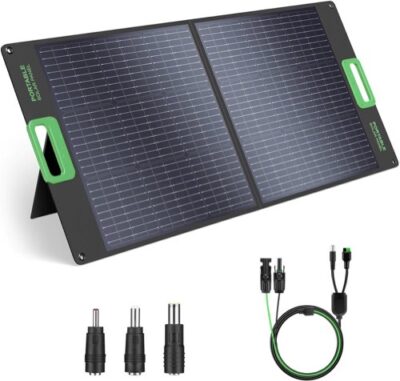
The first question most buyers have is simple: will it plug into the power station I already own? For most people, the answer is yes. The SP-100 ships with a built-in MC4 cable, a 2-in-1 DC 5.5*2.1mm/Anderson cable, and adapters for 3.5*1.35mm, 5.5*2.5mm, and 7.9*0.9mm (8mm) inputs. Owners have connected it to Jackery, Anker, Bluetti, Goal Zero, Rockpals, and EcoFlow without buying anything extra.
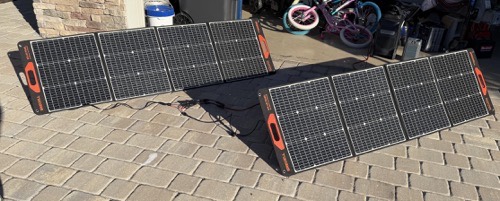
The catch is that adapter coverage isn’t universal. A handful of owners couldn’t find the right terminal for a Jackery Explorer 300 or a Jackery 1000, and newer USB-C-input Jackery models need a cheap DC-to-USB-C adapter. As long as your station accepts the panel’s 20V output and you’ve checked the input plug, you’re golden.
| Power Station / Use | Connector | Compatible? | Notes |
|---|---|---|---|
| Jackery Explorer 500/1000 (older DC input) | 8mm adapter | Compatible | Owners report fast, steady charging |
| Anker SOLIX (C1000, F2600, etc.) | MC4 → XT60 | Needs adapter | Owners add an MC4-to-XT60 cable |
| Bluetti EB series | 8mm / DC adapter | Compatible | Works well per owner reports |
| Goal Zero Yeti | Anderson (APP) | Compatible | Use the MC4-to-Anderson cable |
| Rockpals / EcoFlow River | DC 5.5*2.1mm | Compatible | Confirmed by multiple owners |
| Jackery Explorer 300 | DC adapter | Verify first | Some owners couldn’t find a fitting terminal |
| Jackery 240 v2 / newer USB-C input | USB-C adapter | Needs adapter | Add a cheap DC7909-to-USB-C adapter |
| 12V battery (AGM, LiFePO4, lead-acid) | via controller | Needs adapter | Requires a separate charge controller |
Adapter Check — Before you buy, look at the exact input plug on your power station. The SP-100 covers the common sizes, but matching that plug is what makes this a five-minute setup instead of a return.
Just How Waterproof Is It?
Let’s be direct: there’s no certified IP rating here, just a manufacturer claim of weather resistance. The panel uses durable Oxford cloth with ETFE lamination and is described as dust-resistant and high-temperature resistant, but it is not waterproof. Several owners specifically warn to keep the connection ports out of the rain.
In real use, that’s less of a dealbreaker than it sounds. As more than one owner pointed out, if it’s raining hard the sun usually isn’t out anyway. The panel handles morning dew, brief sprinkles, and outdoor exposure fine — but it’s gear you bring in during a storm, not a permanently mounted rooftop array.
| Feature | This Panel | What It Means Outdoors |
|---|---|---|
| IP rating | None certified | Treat as water-resistant; keep ports dry in rain |
| Frame material | Foldable fabric (Oxford cloth) | Light and flexible; no rigid frame to warp |
| Panel surface | ETFE laminate | Wipes clean easily; lighter than tempered glass |
| Junction box seal | Not stated | Keep the cable junction out of standing water |
| Connector weatherproofing | Not stated | Owners advise shielding the ports from rain |
| Operating temperature | Upper rating 60°C (140°F) | Covers most climates; heat throttling above ~85°F ambient |
| Long-term owner reports | Mostly positive, some early failures | Most hold up; a few units dropped output within months |
Long-Term Ownership — Monocrystalline cells typically degrade slowly over many years, and one owner reported the black Oxford cloth holding up through 110°F-plus Arizona summers with no fading. The likelier weak points are the cable, connectors, and the kickstand hardware — so handle those with a little care.
Install Experience
Setup is genuinely quick. Unfold the panel, flip out the kickstands or hang it from the grommets, plug the right adapter into your power station, and aim it at the sun. Most owners describe it as plug-and-play — no drilling, no controller to configure, no compatibility homework once you’ve matched the connector.
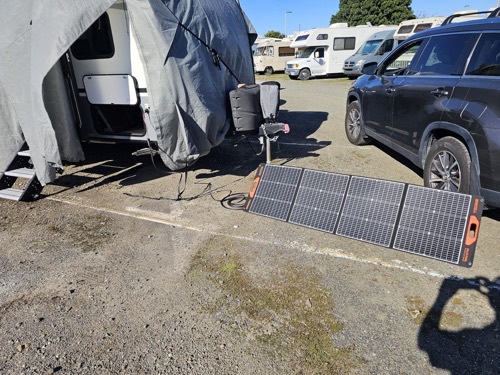
Two things trip people up. First, the kickstands: they’re a bit awkward to deploy thanks to strong velcro and a tendency to fold back in when you lift the panel. One owner’s tip is to slide a trekking pole through the legs for steadier positioning. Second, cable length — the stock cable is fine for keeping the station right next to the panel, but you’ll want more room than that.
The reason is practical. You want the panel baking in full sun while the power station sits in the shade to avoid overheating, and that gap adds up fast. Lots of owners add a 20 ft extension, and some go all the way to 50 ft for flexible placement around a campsite.
Practical Tip — Budget for a 20-30 ft MC4 or DC extension before your first trip. The built-in pouch has room to store it, so it travels with the panel and you’re never “just about” reaching your station.
Certifications and Long-Term Peace of Mind
The SP-100 doesn’t list third-party safety certifications, and there’s no certified IP rating — so you’re relying on GRECELL’s own materials claims (Oxford cloth, ETFE lamination, dust and high-temperature resistance). For a panel you bring in during storms and store between trips, that’s a reasonable bet for most buyers.
Warranty is where things get a little fuzzy. Coverage has varied between owners — one buyer was initially sent a 1-year off-brand panel before receiving a 2-year GRECELL replacement, so it’s worth confirming your exact terms at checkout. A couple of owners did hit real problems: a 100W unit that dropped under 50W after about six weeks, and an early panel failure.
Here’s what tips the balance back in GRECELL’s favor — the customer service. Owner after owner praises fast replacements, instant refunds, and helpful communication. One buyer with a low-output panel called the return process excellent and the credit instant; another got a no-hassle exchange and went out of their way to thank the company by name.
Buyer Heads-Up — If you’re charging a 12V battery directly (car, RV, boat) rather than a power station, you’ll need a separate charge controller — the SP-100 has no onboard controller and no anti-drain diode of its own. For a power station, the station’s built-in input handles that for you.
Who the SP-100 Suits Best
The SP-100 is a different tool for different jobs. It shines as a budget power-station charger and gets shaky the moment you need a sealed, permanently mounted panel.
| Use Case | Fit | Why |
|---|---|---|
| Camping / RV power-station charging | Strong fit | 80-90W real output, folds small, wide adapter set |
| Van life supplemental charging | Strong fit | Lightweight, easy to reposition, packs flat |
| Storm / blackout home backup | Strong fit | Keeps a station topped up during multi-day outages |
| Off-grid cabin or overland setup | Solid fit | Expandable in series/parallel through an MPPT |
| Boat / marine use | Borderline | No IP rating; bring it in, keep ports dry |
| Hot-climate daily charging | With caveats | Heat can throttle output on still, very hot days |
| 12V battery maintenance (car/RV/boat) | With caveats | Works only with a separate charge controller |
| Charging phones directly, no station | Skip | No onboard USB output |
| Permanent rooftop / always-exposed mount | Skip | Water-resistant only; not built for fixed exposure |
| High-draw loads with no battery | Not recommended | It’s a charging panel, not a generator |
You’ll probably be happy if you want:
- Power-station charging that competes with panels costing twice as much
- A self-contained folding panel with all the cables and adapters in one pouch
- Something light enough to re-aim through the day and pack flat in a car or RV
- A budget brand with genuinely responsive customer service behind it
You might want to skip it if you need:
- A certified waterproof panel you can leave mounted outdoors year-round
- Onboard USB ports to charge devices without a power station
- Locking, rock-solid kickstands with zero fiddling
- Guaranteed, uniform output with no unit-to-unit variability
Final Thoughts
For budget-minded buyers who want real power-station charging without paying premium-brand prices, the GRECELL SP-100 is an easy panel to recommend. Owners get output that genuinely competes with the big names, a self-contained folding design, and a wide enough adapter set to plug into almost any station they already own. The trade-offs are honest ones — no certified waterproof rating, finicky kickstands, some QC variability — but none of them undercut the core value.
So here’s the simple buying advice. If you want a portable panel to keep a power station charged for camping, van life, or backup, and you’re fine bringing it inside when the weather turns, this GRECELL SP-100 review lands firmly on the recommend side. If you need a sealed, permanently mounted panel or onboard USB charging, look elsewhere — but for output-per-dollar with a responsive company behind it, the SP-100 punches well above its price.
Pros & Cons Analysis
Based on extensive testing and Amazon customer feedback
Pros
- Strong real-world output for the price — owners consistently report 80-90W in good sun from this 100W panel, with one buyer measuring 86W during peak day even with small clouds around. Several side-by-side testers found it matched or slightly beat a Jackery SolarSaga 100 in the same conditions.
- Briefcase folding design with built-in kickstands — customers love that it folds in half, snaps or magnetically clasps shut, and props itself up with attached legs. The all-in-one carry feel makes it a genuine grab-and-go panel.
- Wide compatibility out of the box — a built-in MC4 cable plus DC adapters and an Anderson connector let owners plug into Jackery, Anker, Bluetti, Goal Zero, Rockpals, EcoFlow and more. Buyers regularly mention it just worked with the power station they already owned.
- Monocrystalline cells with solid efficiency — GRECELL lists up to 23.5% conversion, and owners describe charging fast even on partly cloudy days. Several report decent output (10-15W) under overcast skies rather than a dead stop.
- Lightweight and easy to carry — at roughly 10 pounds for the 100W, owners with aging backs specifically chose it for how easy it is to spread panels around and reposition through the day.
- Built-in cable pocket — the zippered pouch on the back holds all the cables and adapters, and owners often stash their 20 ft extension in it too. It keeps the whole kit self-contained.
- Expandable via series and parallel — owners run two or three panels together (often through a Victron MPPT) and report clean stacking thanks to the consistent 20V output. Pairing roughly doubles the charge rate.
- Responsive customer service — a standout theme. Owners repeatedly praise GRECELL for fast replacements, instant refunds, and helpful communication when a panel underperformed or arrived wrong.
Cons
- No certified IP / waterproof rating — a recurring caution across feedback: the panel is water-resistant, not waterproof, and several owners specifically warn to keep the connection ports out of rain. There's no published IP certification to lean on.
- Kickstands can feel flimsy or finicky — the most common gripe. Several owners describe the legs as awkward to fold out (strong velcro), prone to folding back in when lifted, and not as stiff as they'd like. They work, but they're fiddly.
- Adapter gaps and fit misses for some stations — a subset of owners couldn't find the right terminal for their Jackery Explorer 300 or Jackery 1000, and one notes the included adapters fit nothing they had. Newer USB-C-input Jackery models need a separate cheap adapter.
- Heat throttling in hot climates — owners in Arizona and 85°F-plus conditions report the panel surface gets very hot and output can drop or even stop until it cools. Buyers in hot regions may want a panel rated for higher temperatures.
- Unit-to-unit quality variability — reports include a 100W unit dropping to under 50W after about 6 weeks, an early failure, and one buyer who received a different green-branded panel instead of the orange GRECELL they ordered.
- Short stock cables for campsite setups — multiple owners bought 20 ft or 50 ft extension cables because the panel needs to sit out in the sun while the power station stays in shade nearby.
- Thinner brand recognition and warranty support — GRECELL is less established than Jackery or Bluetti. Warranty terms have varied (one buyer was first sent a 1-year off-brand panel before getting the 2-year GRECELL), so coverage is worth confirming.
- No onboard USB output — several owners wish for a built-in USB-C port so the panel could charge devices directly without a power station. As shipped, it's a DC panel meant to feed a station or controller.
Our Verdict
Charging performance (4.2/5) — The GRECELL SP-100 lands at a real-world 80-90W in good sun from its monocrystalline cells, roughly 80-90% of its 100W rating, with one careful side-by-side test putting it ahead of a Jackery SolarSaga 100. Heat throttling above ~85°F and a handful of low-output or early-failure units keep it short of a top score.
Value & compatibility (4.4/5) — This is the panel's strongest area: output competitive with panels costing far more, broad MC4/DC/Anderson adapter compatibility with Jackery, Anker, Bluetti, Goal Zero, and EcoFlow stations, and standout customer service.
Build & weatherproofing (3.7/5) — The Oxford cloth, ETFE lamination, and folding hardware feel solid, but the flimsy-feeling kickstands and the lack of any certified IP rating (water-resistant only) are real limitations outdoors.
Install & usability (3.9/5) — The self-contained briefcase design, built-in cable pouch, and wide adapter set make setup easy, though the finicky kickstands and short stock cables knock it down a notch.
Bottom line — Best for budget power-station charging — camping, RV and van life, off-grid, and outage backup. Skip it if you need a certified waterproof panel for permanent mounting, onboard USB charging, or guaranteed uniform output.
Frequently Asked Questions
How many watts does the GRECELL SP-100 actually produce?
Owners consistently report 80-90W in good sun from this 100W panel, with one buyer measuring 86W at peak day even with small clouds around. Like any solar panel, it rarely hits the full 100W nameplate, which is a lab (STC) figure — expecting 75-90% of rated output in real conditions is normal. Cooler, bright days tend to push output higher; very hot days can pull it down.
Does the GRECELL SP-100 charge on cloudy days?
Yes, just more slowly. Owners report somewhere around 7-15W on overcast or rainy days and 50-60W on semi-cloudy days, with full sun bringing it back up to the 80-90W range. It keeps collecting energy even when you can't see the sun directly, so it's worth leaving deployed on gray days.
Is the GRECELL SP-100 waterproof?
No — it's water-resistant, not waterproof, and there's no certified IP rating published. The panel uses durable Oxford cloth with ETFE lamination, but several owners specifically warn to keep the connection ports out of rain. Treat it like gear you bring in when a storm rolls through rather than a permanently exposed rooftop panel.
What power stations does the GRECELL SP-100 work with?
It ships with a built-in MC4 cable plus DC adapters (5.5*2.1mm, 3.5*1.35mm, 5.5*2.5mm, 7.9*0.9mm/8mm) and an Anderson connector, so owners have used it with Jackery, Anker, Bluetti, Goal Zero, Rockpals and EcoFlow stations. As long as your station accepts the panel's 20V output, you're set. A few owners couldn't find the exact terminal for a Jackery Explorer 300 or 1000, so check your station's input plug before buying.
Can I connect two GRECELL SP-100 panels together?
Yes. The panel supports both series and parallel connections, and owners regularly run two or three together — often through a Victron or similar MPPT controller — to roughly double or triple the charge rate. The consistent 20V output makes it a clean building block to combine with other panels without overdriving a controller.
Does the GRECELL SP-100 have a USB port for charging phones directly?
No. It's a DC panel designed to feed a power station or a separate charge controller, not to charge devices directly. Several owners specifically wish GRECELL would add a USB-C port inside the cable pouch so the panel could work standalone, but as shipped you'll need a power station or controller in between.
How does heat affect the GRECELL SP-100?
Hot conditions can hurt output. Owners in Arizona and 85°F-plus weather report the surface gets very hot and charging can slow or briefly stop until the panel cools. This is common for solar panels, but if you live somewhere consistently hot, factor in some performance loss during the hottest part of the day.
Are the kickstands sturdy?
They're functional but finicky. The most common complaint is that the attached legs are awkward to fold out (the velcro is strong), can fold back in when you lift the panel, and aren't as stiff as some owners would like. They hold the panel at a good angle once set up, but expect to fiddle with them.
Do I need extension cables?
Often, yes. The panel needs to sit in full sun while the power station ideally stays in the shade to avoid overheating, so many owners add a 20 ft or even 50 ft extension cable. The built-in zippered pouch has room to store the extra cable along with the adapters.
How is GRECELL's customer service and warranty?
Customer service is a standout — owners repeatedly describe fast replacements, instant refunds, and helpful, responsive communication when a panel underperformed or arrived wrong. Warranty terms have varied between units (one buyer was first sent a 1-year off-brand panel before receiving the 2-year GRECELL), so it's worth confirming your specific coverage at purchase.
Technical Specifications
| Brand | GRECELL |
|---|---|
| Model / SKU | SP-100 (ASIN: B0B5H1BC51) |
| Product type | Portable foldable monocrystalline solar panel — for charging portable power stations and solar generators |
| Solar cell type | Monocrystalline silicon with ETFE lamination |
| Maximum power output | 100 W (rated); 80-90W typical real-world based on customer reports |
| Open-circuit voltage (Voc) | Not specified |
| Maximum operating voltage (Vmp) | 20 V (stated maximum voltage / output voltage) |
| Output voltage | 20 V DC |
| Maximum current (Imp) | 5 A (amperage capacity; connector rated to 25A max) |
| Short-circuit current (Isc) | Not specified |
| Cell efficiency | Up to 23.5% (manufacturer-stated monocrystalline) |
| Charge controller included | No — direct DC output; feeds a power station input or separate controller |
| Controller features | N/A (no onboard controller; pair with the station's input or an external MPPT/PWM) |
| Connector type | MC4 (built-in cable); 2-in-1 DC 5.5*2.1mm/Anderson; adapters for 3.5*1.35mm, 5.5*2.5mm, 7.9*0.9mm (8mm) |
| Cable length | Not specified (owners frequently add 20-50 ft extension cables) |
| Waterproof rating | No certified IP rating (water-resistant Oxford cloth + ETFE lamination; keep ports out of rain) |
| Operating temperature range | Upper rating 60°C (140°F) (owners report output throttling in very hot, still conditions above ~85°F ambient) |
| Dimensions (L × W × H) | 50.5" × 21.1" × 0.2" (unfolded); ~25.25" × 10.55" × 3" (folded) |
| Weight | 10.3 lb |
| Frame material | Foldable fabric panel (durable Oxford cloth backing — no rigid metal frame) |
| Surface / glass material | ETFE lamination over monocrystalline cells |
| Mounting type | Built-in kickstands (one per side); reinforced grommets for hanging/tie-down |
| Compatible devices / batteries | Portable power stations and solar generators (Jackery, Anker, Bluetti, Goal Zero, Rockpals, EcoFlow and more via included adapters); 12V batteries when paired with a separate charge controller |
| Required sunlight hours | 4 peak sun hours/day delivers ~328 Wh (estimated at 0.82 real-world factor) |
| Wind / snow load rating | Not specified |
| Safety certifications | Not specified |
| Special features | Briefcase bifold design; built-in zippered cable pouch; built-in kickstands; reinforced grommets; series/parallel expandable; wide adapter set; responsive customer service |
| Included in the box | 1× 100W 20V foldable solar panel, 1× 2-in-1 cable (DC 5.5*2.1mm/Anderson), 1× DC5.5*2.1mm to 3.5*1.35mm adapter, 1× DC5.5*2.1mm to 5.5*2.5mm adapter, 1× DC5.5*2.1mm to 7.9*0.9mm (8mm) adapter |
| Warranty | Not specified (owner reports vary; one received a 2-year GRECELL panel — confirm coverage at purchase) |
| Expected lifespan | Not specified (panels generally last 25-30 years; a few owners reported early output drops or failures within months) |
| Unit count | 1 |
| Best for | Budget-conscious camping, RV and van life, off-grid backup, and emergency power-station charging |