Renogy 400W Solar Panel Blanket Review: The Flexible Panel That Mounts Where Rigid Panels Can’t
At a Glance
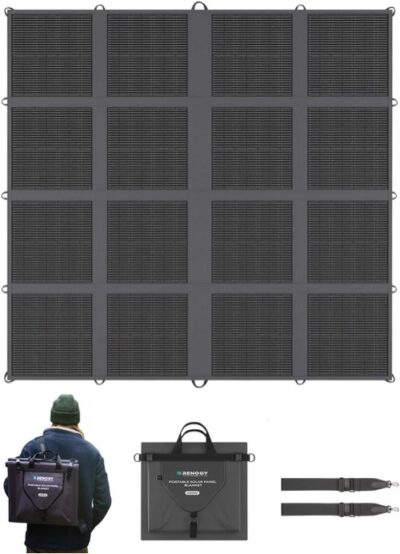
KEY FEATURES
- Power output: 400 W (rated); N-Type monocrystalline cells with ETFE lamination
- Electrical: Voc 39.2V; Vmp 33.6V; Isc 13.1A; Imp 11.9A
- Cell efficiency: 25% (16BB N-Type cell technology)
- Weatherproofing: IP65 — water-resistant (not waterproof); ETFE laminate; rated -10°C to 65°C
- Charge controller: None included — connects to a power station's built-in MPPT or a separate solar controller
- Best for: Van life, RV and overland setups, off-grid camping, marine use, and emergency backup where high wattage needs to pack down small
PROS
- Real output often hits 320-396W, sometimes 435W+ in cool sun
- Compact 16-fold design, about 16 lbs — small for 400W
- Strong output even laid flat — no stand needed
- Fast charging for Bluetti, EcoFlow, Jackery, Goal Zero stations
- Renogy brand reliability and quality build feel
CONS
- Tie-down loops tear out in light wind — the top complaint
- MC4 connectors only — adapter cable needed and not included
- Some units fall short of rated output (230-300W reported)
- IP65 is water-resistant, not waterproof — pack it up in rain
- Short return window; occasional early failures and slow support
Editor's Choice
Based on rigorous testing & Amazon customer feedback
☀ Solar Panel Output Calculator
Estimate how much energy the Renogy 400W Solar Panel Blanket produces — and what it can power or charge.
Solar Setup
Portable devices
Power stations & batteries
Click devices to add them to your load list, adjust hours and quantity, then calculate.
Portable / Camping
Home Appliances
No devices added yet. Click chips above or add a custom device.
How many back-to-back sunless days should the battery keep you running? Example: 1 = one cloudy day, 3 = three cloudy days in a row.
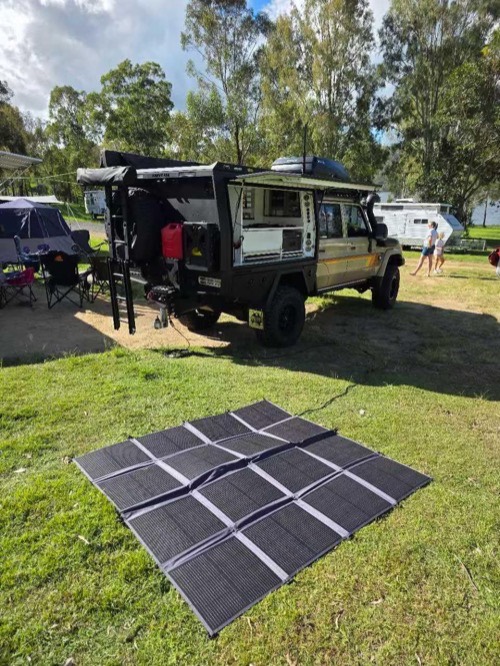
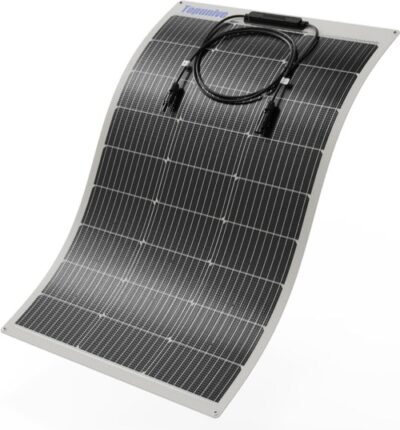
This Renogy 400W solar panel blanket review is for anyone who’s stared at a curved van roof, a fiberglass boat cabin, or a packed truck bed and thought, “There’s no way a rigid glass panel fits here.” This one rolls up, folds down to about backpack size, and bends to surfaces where a framed aluminum panel simply can’t go — all while pushing a full 400 watts.
Here’s the problem it solves. Van roofs, boat decks, and irregular RV surfaces are terrible matches for stiff, glass-faced panels. Drilling brackets into a curved or delicate surface is a headache, and a 400W rigid panel is a heavy, awkward slab to store. Plenty of owners already had bulky 400W suitcase panels and wanted the same power without the bulk.
Now the honest part. A flexible ETFE blanket is lighter and far more packable than tempered glass, but going frameless means there’s less protecting the cells from physical knocks. At 400W and roughly 5 feet square unfolded, this is a panel you deploy and manage with some care, not a tiny grab-and-go charger. Set your expectations there and it makes a lot more sense.
At a Glance
| Spec | Value |
|---|---|
| Max Power Output | 400 W (N-Type monocrystalline) |
| Output Voltage | 33.6 V DC (Vmp); 39.2 V Voc |
| Connector | MC4 / IP68 solar (adapter needed for power stations) |
| Cell Efficiency | 25% |
| Weatherproof Rating | IP65 (water-resistant, not waterproof) |
| Charge Controller | None — uses power station MPPT or external controller |
| Cable Length | 10 ft (3 m) |
| Mount Type | Edge loops/grommets, handle, 2 shoulder straps (no rigid bracket) |
| Best For | High wattage on curved or tight spaces — vans, RVs, boats, overland |
Is the Renogy 400W Blanket Worth It? Quick Take
If you want serious wattage that packs down small and bends to awkward surfaces, the Renogy 400W solar panel blanket delivers — and often beats its rating. It’s genuinely compact for 400W, it pulls strong power even laid flat, and it tops up power stations from Bluetti, EcoFlow, and Jackery fast. Just know going in: the tie-down loops are weak and tear in light wind, it ships with MC4 connectors only (you’ll buy an adapter), and IP65 means water-resistant, not waterproof. Plan for those three things and most buyers end up happy.
Flexible Solar Panel vs. Rigid Panel: What Changes
Form factor is the whole story of this Renogy 400W solar panel blanket review, so it’s worth pausing on what flexible actually buys you. The biggest difference you’ll feel is weight and shape. This blanket weighs around 16 lbs and folds flat, while a rigid 400W panel is a heavy, glass-faced slab that needs real storage space. Owners who already own Renogy’s 400W suitcase panel describe this one as “shockingly more compact” — a huge win when every inch in a van or rig counts.

Mounting changes too. Rigid panels usually mean drilled brackets and a flat, sturdy surface. A flexible blanket drapes over a windshield, lays on the ground, or hangs from a rack with hooks and straps. You can curve it across a van roof or boat cabin where a framed panel would never sit flush. The trade-off: there’s no frame to take a hit, so the cells are more exposed to scratches and bending stress over time.
Efficiency isn’t a compromise here. These are 25% N-Type cells, which is higher than the ~22.5% you see on a lot of standard panels — and owner output numbers back that up. You’re giving up frame protection and a little long-term ruggedness, not raw power.
Form Factor and Build
Out of the box, the build feels solid. Skeptical buyers — including a few who admit they doubt gear made overseas — consistently call out the quality and “well-made” feel. The 16-fold design folds into a tidy square with a padded handle, and the ETFE laminate gives it that bendable, fabric-like character.
It’s lighter than most 400W panels, but don’t picture a beach towel. With cables and the shoulder strap, real-world weight creeps toward 17 lbs, and the panel is stiffer and bulkier in hand than the word “blanket” suggests. Taller owners and solo users mention it’s awkward to wrangle in any wind.
Heads Up — Several owners wish Renogy printed fold-direction markings on the panel. Refolding it neatly takes a couple of tries to learn — though one owner’s four-year-old eventually got the hang of it, so it’s not rocket science.
A few quality issues do show up. A handful of buyers received units with a cracked cell corner or early delamination, and a couple reported the thin wires between panels overheating. These are clearly the exception against a wave of positive build feedback, but they’re worth knowing before that 30-day window closes.
Output When the Sun’s Out
This is where the panel earns its keep, and it’s the part of this Renogy 400W solar panel blanket review most buyers skip straight to. Laid flat at midday, most owners report 320-396W — already excellent for a foldable 400W panel. Push it further in cool, clear conditions and the numbers get wild: one owner logged 457W, another saw 476W on a cooler day. Cold cells run more efficiently, and the readings prove it.

A few real-world snapshots from owners:
| Conditions | Reported output |
|---|---|
| Cool, clear day, flat on ground | 435-476W |
| Full sun, flat, midday | 320-396W |
| Aligned to the sun, good day | 385-395W |
| Spring sun, not yet peak | 232-280W |
| Mostly cloudy / partial cover | 200-300W |
| Less-than-ideal light | ~100-170W |
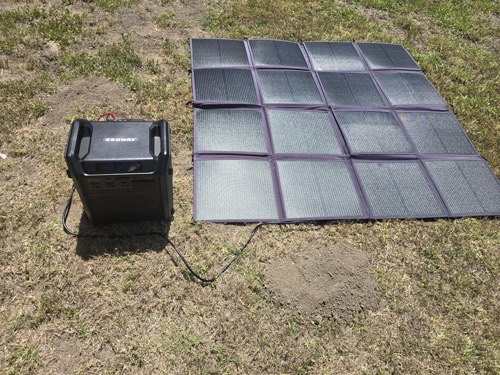
Charging speed matches those numbers. Owners describe a Delta 2 going 68% to 100% in about an hour, a Goal Zero 1250 climbing 40% to 100% in 3-4 hours while running a freezer, and multiple Bluetti and EcoFlow stations topping up fast.
Now the caveat. Not everyone hits the rating. A minority cap out around 230-300W even in strong sun, and one electronics engineer who tested it carefully in Florida measured roughly 230W across several tilt angles and called the wattage over-advertised. There’s real unit-to-unit variation here, so test yours early and hard.
Pro Tip — In windy areas, lay it flat instead of fighting to angle it. Owners report 300-385W flat at midday, and a flat panel won’t catch the wind and flap your weak tie-down loops loose.
What It Connects To
Compatibility is broad. It charges 12V and 24V battery systems — AGM, LiFePO4, and deep cycle — and pairs with most major power stations. Owners run it with Bluetti (including the big AC180), EcoFlow Delta 2, Delta 3, and Delta Pro 3, Jackery, and Goal Zero units without trouble.

The catch is the connector. The 10ft cable ends in MC4 solar connectors only, so you’ll need the right adapter to plug into your station. Owners frequently mention buying an XT60 (one notes you need an XT60i, not a plain XT60, to get full power on EcoFlow) or a proprietary cable. Budget for that extra cord — it’s not in the box, and a couple of buyers were caught off guard.
| Pairing | Works? | Notes |
|---|---|---|
| Bluetti power stations (incl. AC180) | Yes | Fast top-ups; needs correct adapter |
| EcoFlow Delta 2 / 3 / Pro 3 | Yes | Use XT60i for full power |
| Jackery / Goal Zero stations | Yes | Plug-and-play with the right cable |
| 12V/24V battery (AGM, LiFePO4, deep cycle) | Yes | Needs a solar charge controller |
| Two panels in series | Yes | Owners run 450W+ loads through a 60-90V inverter |
| Direct to a device (no controller) | No | DC panel — must go through a controller or station |
You can also run two in series. One owner pushes 450W loads straight through a 60-90V inverter, skipping the battery — handy for daytime high-draw use.
How It Handles the Elements
The IP65 rating is the line to understand here: water-resistant, not waterproof. Light dust and a quick splash are fine, but this isn’t a panel to leave out through a storm. More than one owner mentions the annoyance of dashing out to pack it up the moment it starts to drizzle.
The ETFE laminate handles sun and heat well — Renogy rates it from -10°C to 65°C, and an owner in Yuma testing at 91°F and even 113°F reported it still over-performing. Heat isn’t the enemy; standing water and rough handling are.
The honest knocks: one owner saw delamination start within days, and a couple noted the panel feels more fragile than a framed unit because there’s nothing protecting the surface. If your install lives outdoors full-time in a wet climate, treat this as a fair-weather or quick-deploy panel rather than a permanent rooftop fixture.
Unfolding and Setting Up
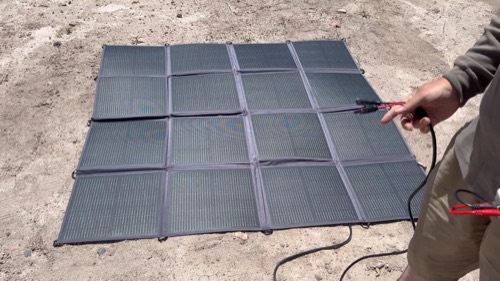
Setup is genuinely quick. Unfold, lay it flat or drape it, plug in. Owners describe getting strong wattage within minutes, often without fussing over the angle. The flexibility is the fun part — windshield, hood, roof rack, picnic table, or hung between trees, whatever catches the sun.
The weak point is anything involving the tie-down loops. These small fabric edge loops are the panel’s most-complained-about feature by a wide margin — they tear out or come unglued in light wind, leaving you unable to hang or angle it. Renogy support has told owners to reattach them within an eighth of an inch of the edge, which is a fiddly fix.
Pro Tip — Skip the stock loops for hanging. Owners have better luck running Command hooks, S-hooks, or hammock straps through the metal grommets. Buy your own carabiners too — they’re not included.
One more small thing: the storage pouch fits the cable plus a multi-adapter, but it’s a snug squeeze. Take care not to kink the cable jamming it back in.
What to Expect Over Time
On paper, the safety credentials are strong. The panel is UL 61730 certified and CE, RoHS, FCC, CA65, and PSE compliant, built in an ISO 9001 facility. That’s a more complete certification list than many no-name folding panels can show.
Renogy backs it with a 2-year material and workmanship warranty. The real-world catch is Amazon’s 30-day return window, which closes long before the warranty does. One frustrated owner discovered a dead unit after the return window had passed and was stuck making payments on a non-working panel — so test thoroughly and immediately.
Support experiences are mixed. Plenty of buyers chose Renogy precisely because their older gear has lasted (one mentions a 12-year-old Renogy panel still going), but a few describe slow or unhelpful technical support and warranty foot-dragging when a unit failed early. Buying from Renogy or an authorized seller, and confirming output on day one, are your best protections.
The Buyers Who’ll Love It — Use-Case Fit Matrix
| Use Case | Fit | Why |
|---|---|---|
| Van life / camper high-wattage charging | Strong fit | High output, packs down small, bends to curved roofs |
| RV battery and power-station charging | Strong fit | Fast top-ups for big LiFePO4 banks and stations |
| Overlanding / off-road truck setups | Strong fit | Compact fold saves space in a packed rig |
| Off-grid camping (fridge, lights, devices) | Strong fit | Keeps stations and 460Ah banks charged for days |
| Boat / marine deck charging | Solid fit | Flexible, bends to cabins — but pack up in rain |
| Emergency / blackout backup power | Solid fit | High wattage stows easily until needed |
| Two-panel series for high daytime loads | Solid fit | Owners run 450W+ through a 60-90V inverter |
| Hanging or steeply angled mounting | With caveats | Stock tie-down loops tear; use grommets and hooks |
| Permanent outdoor rooftop install (wet climate) | Borderline | IP65 is water-resistant only; no frame protection |
| Buyer who needs guaranteed lab-rated output | With caveats | Most beat 400W, but some units cap at 230-300W |
| One-person setup in windy spots | Borderline | Large and awkward to wrangle solo in wind |
| Tiny grab-and-go charger for a phone | Skip | This is a big, high-wattage panel — overkill |
You’ll probably be happy if you want:
- A 400W panel that folds to backpack size and bends to curved van or boat surfaces
- Fast charging for a Bluetti, EcoFlow, Jackery, or Goal Zero station
- Strong output even laid flat, with no stand to mess with
- A trusted brand with a real certification list behind it
- The flexibility to set up over a windshield, on the ground, or on a rack
You might want to skip it if you need:
- A truly waterproof panel for permanent outdoor mounting
- Rock-solid tie-down loops for routine hanging out of the box
- Guaranteed exact rated output from every single unit
- A small, light grab-and-go charger for phones and small devices
- A panel that comes ready to plug into your power station with no extra adapter
So — Is the Blanket Worth It?
For van lifers, RV owners, boaters, and off-grid campers who need real wattage that bends to awkward spaces and stows small, the answer in this Renogy 400W solar panel blanket review is yes — with eyes open. The output is the headline: most owners meet or beat the 400W rating, charging speeds are fast, and the compact fold is a genuine space-saver over a rigid 400W slab. The Renogy name and the full certification list add real peace of mind.
The trade-offs are specific and manageable. Plan to reinforce or work around the flimsy tie-down loops, buy the right MC4 adapter for your station, keep it out of heavy rain since IP65 isn’t waterproof, and test the panel hard within your return window in case you drew one of the underperforming units. Do those four things, and for the buyer who needs flexible high-wattage solar where rigid panels can’t go, this Renogy solar panel earns its spot in the rig.
Pros & Cons Analysis
Based on extensive testing and Amazon customer feedback
Pros
- Real-world output that hits — and often beats — its rating — buyers consistently report 320-396W laid flat, with multiple owners measuring 435W, 457W, even 476W in cool, clear conditions. For a foldable 400W panel, that's unusually close to (or past) the nameplate number.
- Genuinely compact and light for 400W — the 16-fold design packs down to roughly backpack size and weighs about 16 lbs. Customers who own bulkier 400W suitcase panels call this a huge space win for overlanding, vans, and packed rigs.
- Works well laid flat — no stand required — a recurring theme is strong output even flat on the ground, which suits windy areas where an angled panel would catch the breeze. Owners report 300-385W flat at midday.
- Charges power stations fast — owners pairing it with Bluetti, EcoFlow, Jackery, and Goal Zero units describe quick top-ups, like 68% to 100% on a Delta 2 in about an hour or 40% to 100% on a Goal Zero 1250 in 3-4 hours while running a freezer.
- Renogy brand trust and build quality — many buyers chose it specifically because they've owned Renogy gear for years (one mentions a 12-year-old Renogy battery). The craftsmanship and "quality feel" come up repeatedly, even from skeptics.
- Flexible mounting options — drape it over a windshield or hood, lay it on the ground, clip it to a roof rack, or hang it between trees. Owners like switching placement to chase the sun without much effort.
- Easy to fold, carry, and stow — the padded handle and shoulder straps get praise, and one owner's four-year-old managed to fold it back up. It tucks into under-bed "garage" storage and behind seats without drama.
- Generous cable length and a usable storage pocket — the 10ft cable is longer than many folding panels, and the attached pouch holds the cord plus a multi-adapter, though it's a snug fit.
Cons
- Tie-down loops tear out easily — the single most repeated complaint. Owners describe the small fabric securing loops ripping or coming unglued in light wind, leaving them unable to hang or angle the panel. Several say it would be a 5-star product if not for this.
- Comes with solar connectors only — you'll need an adapter — the panel ends in MC4 connectors with no power-station adapter included. Multiple buyers spent extra on XT60 or proprietary cables, and a few felt blindsided that the box doesn't include what they need to plug into their station.
- Some buyers can't reach rated output — a minority report topping out around 230-300W even in good sun. One electronics engineer measured roughly 230W max across multiple tilt angles in Florida and called the wattage over-advertised.
- Reports of early failures and weak inter-panel wiring — a handful of owners had units stop working within weeks, with a couple noting the thin wires between cells overheating. These are the exception, but they're serious when they happen.
- Warranty window is short and support can frustrate — the 2-year material warranty exists, but owners point out Amazon's 30-day return window closes fast, and a few describe slow or unhelpful technical support when something goes wrong.
- Not truly waterproof — the IP65 rating is water-resistant, not waterproof. Owners report scrambling to pack it up at the first drizzle, and at least one saw delamination start early. It's not a leave-it-out-in-the-rain panel.
- Awkward to handle and refold for some — taller users and solo setup-folks find the large flexible panel unwieldy in wind, and several wish for printed markings showing how to fold it back up correctly.
- Heavier and less "blanket-like" than expected — with cables and strap, real-world weight climbs toward 17 lbs, and a few buyers note it's stiffer and bulkier in hand than the marketing suggests.
Our Verdict
Charging performance (4.3/5) — Most owners measure 320-396W flat, with several hitting 435-476W in cool, clear conditions — strong real-world numbers for a foldable 400W panel. The score isn't higher because a real minority cap out at 230-300W, suggesting unit-to-unit variation.
Value & compatibility (4.1/5) — Works with AGM, LiFePO4, and deep-cycle 12V/24V systems plus most major power stations. The Renogy name and frequent above-rated output add value; the short return window and the separate adapter purchase temper it.
Build & weatherproofing (3.6/5) — The cells and ETFE laminate feel well made, but the tear-prone tie-down loops, IP65-only (not waterproof) rating, and scattered reports of delamination, broken cells, and overheating inter-panel wires pull this down.
Install & usability (4.0/5) — Compact fold, light weight, long cable, and flexible placement are real strengths. Refolding confusion, solo handling in wind, and the missing power-station adapter knock it below the top tier.
Bottom line — Best for vehicle-based high-wattage power that packs down small — van life, RV and overland setups, off-grid camping, marine use, and emergency backup. Skip it if you need a truly waterproof rooftop panel, rock-solid tie-down loops out of the box, or guaranteed lab-rated output from every unit.
Frequently Asked Questions
Does the Renogy 400W solar blanket actually produce 400 watts?
Often, yes. Most owners report 320-396W with the panel laid flat at midday, and several measured 435W, 457W, even 476W in cool, clear conditions — partly because cooler cells run more efficiently. That said, a minority cap out around 230-300W even in good sun, and one engineer measured roughly 230W max in Florida. Expect strong output near the rating in good light, but know there's some unit-to-unit variation.
What connector does the Renogy 400W blanket use, and can it charge my power station?
The 10 ft cable ends in MC4 (IP68 solar) connectors only. It charges 12V/24V battery systems (AGM, LiFePO4, deep cycle) and works with most power stations from Bluetti, EcoFlow, Jackery, and Goal Zero — but you'll need to buy the right adapter cable (often XT60 or a proprietary plug). The box doesn't include a power-station adapter, so plan for that extra purchase.
Is the Renogy 400W solar panel blanket waterproof?
No. It's rated IP65, which is water-resistant, not waterproof. Light dust and brief splashing are fine, but owners recommend packing it up if rain starts rather than leaving it out in a downpour. For permanent outdoor mounting in wet climates, treat it as a fair-weather or quick-deploy panel.
Do I need a stand, or does it work laid flat?
It works well laid flat — a recurring point in owner feedback. People report 300-385W flat on the ground or a vehicle hood at midday. Angling it toward the sun squeezes out more, but flat placement is genuinely practical, especially in windy areas where an angled panel would catch the breeze.
How well do the tie-down loops hold up?
This is the panel's weak spot. The small fabric edge loops are prone to tearing or coming unglued, sometimes in light wind. Many owners use Command hooks, S-hooks, or hammock straps through the grommets instead, or just lay the panel flat. If you plan to hang or angle it regularly, expect to reinforce or work around the loops.
What's the warranty, and what's the catch on returns?
Renogy backs it with a 2-year material and workmanship warranty. The catch is Amazon's 30-day return window closes quickly, so test the panel thoroughly when it arrives. A few owners describe slow or frustrating technical support, so confirm it produces power right away rather than waiting weeks.
How compact and heavy is it really?
The 16-fold design packs down to about 16.5 x 15.8 x 4.1 inches — close to backpack size — and the panel weighs around 16 lbs. With cables and the shoulder strap, real-world carry weight climbs toward 17 lbs. It's notably smaller and lighter than typical 400W suitcase panels, though it's stiffer and bulkier in hand than the word 'blanket' might suggest.
Who is the Renogy 400W blanket best for?
It's aimed at van lifers, RV and overland travelers, boaters, and off-grid campers who need high wattage that packs down small and adapts to curved or awkward surfaces. It's great for fast power-station charging and flexible placement. It's less ideal if you need a permanent, waterproof rooftop install or guaranteed lab-rated output every time.
Technical Specifications
| Brand | Renogy |
|---|---|
| Model / SKU | RSP400SB (MPN: RSP400SB-G3; ASIN: B0F4JR1PFM) |
| Product type | Portable foldable flexible solar panel blanket — for power stations and 12V/24V battery systems |
| Solar cell type | N-Type monocrystalline silicon (16BB cell technology) with ETFE lamination |
| Maximum power output | 400 W (rated); commonly 320-396W real-world flat, up to 435-476W reported in cool clear sun; some units 230-300W |
| Open-circuit voltage (Voc) | 39.2 V |
| Maximum operating voltage (Vmp) | 33.6 V |
| Output voltage | 33.6 V (Vmp) DC |
| Maximum current (Imp) | 11.9 A |
| Short-circuit current (Isc) | 13.1 A |
| Cell efficiency | 25% (N-Type, higher than standard ~22.5% panels) |
| Charge controller included | No — connects to a power station's built-in MPPT or a separate solar charge controller |
| Controller features | N/A (no controller in box; output regulated by the connected station or controller) |
| Connector type | MC4 / IP68 solar connectors (adapter to XT60 or proprietary plug needed for power stations — not included) |
| Cable length | 10 ft (3 m) (non-detachable; many owners add an extension) |
| Waterproof rating | IP65 (water-resistant — not waterproof; pack up in rain) |
| Operating temperature range | -10°C to 65°C (14°F to 149°F) |
| Dimensions (L × W × H) | 64.96" × 62.99" × 1.50" (unfolded); 16.54" × 15.83" × 4.13" (folded) |
| Weight | 16.09 lb (7.3 kg) (closer to 17 lb with cables and strap, per owners) |
| Frame material | Frameless — flexible ETFE laminate construction with reinforced stitching |
| Surface / glass material | Military-grade ETFE lamination (no glass) |
| Mounting type | Edge attachment loops/grommets for hanging; padded carry handle; 2 shoulder straps (carabiners/hooks not included; loops are weak) |
| Compatible devices / batteries | 12V/24V battery systems (AGM, LiFePO4, deep cycle); portable power stations (Bluetti, EcoFlow, Jackery, Goal Zero) via adapter |
| Required sunlight hours | 4 peak sun hours/day delivers ~1,280 Wh (estimated at 0.80 real-world factor) |
| Wind / snow load rating | Not specified |
| Safety certifications | UL 61730 certified; CE, RoHS, FCC compliant; CA65, PSE; manufactured in an ISO 9001 facility |
| Special features | 16-fold compact design; 25% N-Type cells; folds to 100W/200W/300W along widest seams; multiple installation methods; storage pouch for cable |
| Included in the box | 1× 400W Solar Blanket, 2× shoulder straps |
| Warranty | 2-year material and workmanship warranty |
| Expected lifespan | Not specified (one owner reports a 12-year-old Renogy panel still in use; a few report early failures) |
| Unit count | 1 |
| Best for | Van life, RV and overland setups, off-grid camping, marine use, and high-wattage emergency backup that packs down small |