Enphase IQ PowerPack 1500 Review: Quiet Backup Power for Fridges, RVs, and Home Outages
At a Glance
KEY FEATURES
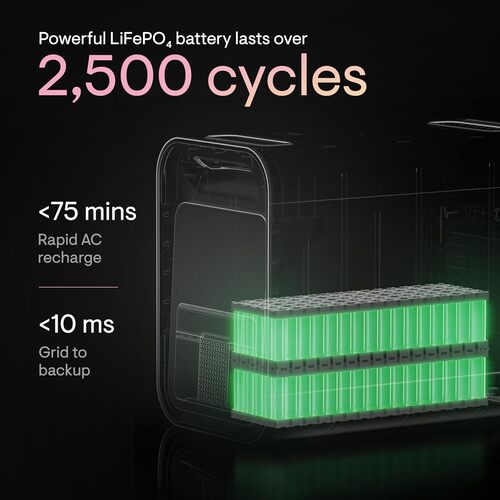
- Battery: 1,500Wh, LiFePO4 / LFP chemistry, 2,500-cycle rated.
- AC output: 1,500W continuous, 1,500W listed starting wattage, clean AC output from built-in IQ8 microinverters.
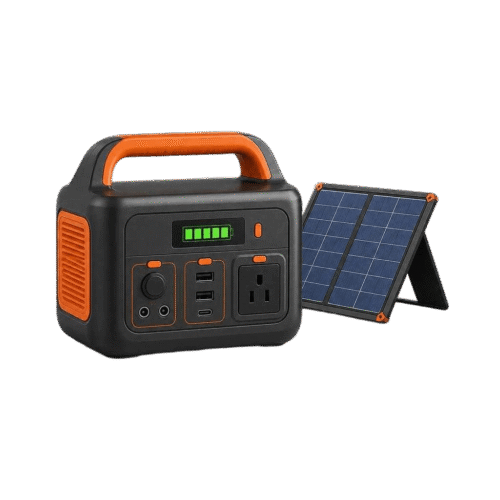
- Ports: 4 AC outlets, 2 USB-C ports, 4 USB-A ports, 1 DC 12V output.
- Recharge: AC under 75 minutes, solar roughly 4 hours with compatible panels, car charging via included DC 12V charging cable.
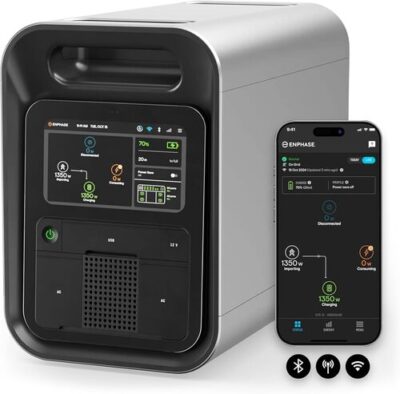
- Smart features: Enphase app support, 7-inch color LCD touchscreen, built-in 4G cellular, Wi-Fi, Bluetooth, OTA updates, remote monitoring, sub-10ms grid-to-backup switch.
- Best for: Refrigerator backup, routers, laptops, medical-device support, RV use, overlanding, car camping, and quiet indoor outage prep.
PROS
- 1,500Wh usable LFP capacity with clearly published electrical limits.
- Touchscreen plus Wi-Fi, Bluetooth, and LTE monitoring options.
- Under-10ms transfer specification and four pure-sine AC outlets.
- Published UL certifications and five-year / 2,500-cycle warranty.
CONS
- 1,500VA continuous output is modest for a 1.5kWh premium station.
- 45.9 lb makes the optional cart relevant for regular movement.
- 440W solar input and 10A ceiling require disciplined array matching.
- Premium price is difficult to justify without valuing the Enphase ecosystem and documentation.
Editor's Choice
Based on exact documentation and qualitative exact-ASIN owner evidence; no hands-on test or population-rate claim
⚡ Can the Enphase IQ PowerPack 1500 Run It?
Choose a common device and see the estimated runtime, whether the inverter can handle it, and how long the power station may take to recharge.
Picture this: the power drops, the refrigerator starts warming up, your router dies, and the old gas generator is sitting outside in freezing weather. You don’t need to run the whole house. You just need quiet, dependable power for the stuff that matters.
The Enphase IQ PowerPack 1500 works best as a clean indoor backup for fridges, routers, workstations, furnace fans, and short outage loads. That said, it also has real portable appeal for RV owners, campers, overlanders, and anyone already living in the Enphase solar ecosystem.
The Enphase IQ PowerPack 1500 is a different value proposition from a watt-heavy marketplace station. The official data sheet specifies 1,532Wh rated / 1,500Wh usable LFP capacity, 1,500VA continuous and 3,000VA for two seconds, four 120V AC receptacles, a 440W solar input, under-10ms transfer, touchscreen controls, Wi-Fi, Bluetooth, and LTE. It also publishes safety certifications and a five-year or 2,500-cycle warranty. Buyers pay for integration, documentation, and control—not class-leading inverter output.
The owner material is smaller than the other evidence sets but covers solar charging, refrigerator and electronics backup, portability, display/app setup, quiet operation, high-draw use near the ceiling, and support. Positive reports emphasize finish, controls, fast AC recovery, and the fit with an existing Enphase relationship. Critical reports include account/setup friction, premium price, mobility, and isolated arrival or remedy problems. The evidence is directional and cannot establish prevalence.
The 1,500VA ceiling should sit at the top of the appliance worksheet. A kettle near 1,350W can leave little margin for another device or voltage variation. A microwave’s advertised cooking power may be lower than its electrical input. Motors add startup demand. Run the hardest load alone, record actual watts, and add other devices only after repeated starts remain stable. For long backup, average energy matters more than the brief surge rating.
| Use case | PowerPack fit | Proof before relying on it |
|---|---|---|
| Router, laptop, display, security | Strong continuity role | Transfer and recovery drill; notification settings |
| Refrigerator | Potentially strong energy fit | Compressor startup and full duty-cycle measurement |
| Kitchen heating appliance | Near the output boundary | Input wattage—not cooking rating—and all simultaneous loads |
| Existing Enphase household | Strong ecosystem rationale | Confirm exact standalone/integration features available in the current configuration |
Solar input is tightly documented: 12–50V operating, 60V absolute maximum, 10A, and 440W. That is enough for a useful portable array, but it rules out casual series-string design. Calculate cold Voc below 60V, confirm operating voltage stays above the controller minimum, keep current within 10A, and match the connector/polarity specified by Enphase. A physically compatible cable does not make an excessive array safe.
Connectivity can be valuable during an outage because it improves visibility, but it also creates setup dependencies. Confirm which functions work locally when internet service is absent. Test notifications instead of assuming an app will announce battery mode. Record configuration screens so a firmware update or replacement unit can be returned to the same policy.
At 45.9 pounds, the PowerPack is relocatable but benefits from the optional cart or a dedicated indoor position. Keep ventilation clear, protect it from water, and plan cable access. Four AC outlets do not raise the 1,500VA total, and a power strip does not create additional inverter capacity.
IQ PowerPack 1500: Premium Controls Around a 1,500W Limit
For anyone who wants quiet emergency power without dragging out a gas generator, the Enphase IQ PowerPack 1500 review story is pretty strong. It has useful 1,500Wh capacity, a 1,500W AC output ceiling, fast wall charging, a clear touchscreen, app monitoring, and safety certifications that matter for indoor use. The catch is that it’s heavy, the provided specs don’t list a higher surge rating, and the exact maximum solar input wattage isn’t published in the product data. Still, for fridge backup, RV use, and home outage essentials, it’s a solid pick.
A 45.9-Pound Indoor-First Portable System
The IQ PowerPack 1500 has a more polished feel than a lot of boxy portable batteries. Owners mention the smooth outer shell, recessed port panels, covered connections, and carry-friendly handle design as things that make it easier to pack in a truck or keep tucked near a wall.
At 45.9 lb, though, it has real heft. You can move it around the house or lift it into a vehicle, but it’s not something most people will casually carry across a long campground. In practice, the optional cart makes sense for anyone using it as a home backup battery.
Port placement gets good feedback. Inputs and outputs sit on opposite sides, and the recessed panels help protect plugs from bumps when the unit is packed against gear.
Worth Knowing — This is portable in the “move it from garage to fridge” sense, not the “carry it down a hiking trail” sense. For car camping, RVing, and home backup, 45.9 lb is workable. For backpacking, skip it.
Rated Capacity, Usable Capacity, and the Reserve Question
The Enphase IQ PowerPack 1500 has a 1,500Wh battery. In normal language, that means enough stored energy to run small electronics for a long time, a refrigerator for many hours, or a high-draw appliance briefly.
Owners use it in exactly those ways. Feedback mentions refrigerators, routers, laptops, dual monitors, lights, handheld devices, a furnace fan, a Peloton, a hot glue gun, and even medical-device backup during evacuation planning.
| Device | Typical Power Draw | Estimated Runtime | Realistic with Margin |
|---|---|---|---|
| Smartphone charging | 10-15Wh per charge | 85-125 charges | About 75-110 charges |
| Laptop | 50-80Wh per charge | 16-25 charges | About 14-22 charges |
| Wi-Fi router | 10-20W | 64-128 hours | About 55-110 hours |
| CPAP, no humidifier | 30-60W | 21-43 hours | About 18-36 hours |
| CPAP, humidifier on | 50-90W | 14-26 hours | About 12-22 hours |
| Mini fridge | 40-80W cycling | 16-32 hours | About 14-27 hours |
| Full-size refrigerator | 100-200W cycling plus surge | 6-13 hours | About 5-11 hours |
| Electric blanket | 50-80W | 16-26 hours | About 14-22 hours |
| Drone battery charging | 60-100Wh per battery | 13-21 charges | About 11-18 charges |
| 1,350W electric kettle | 1,350W | About 55 minutes total draw | Brief use only |
| 1,500W load at ceiling | 1,500W | About 50 minutes total draw | Brief use only |
Real-World Math — At 0.85 AC efficiency, the listed 1,500Wh battery delivers roughly 1,275Wh through the AC outlets. Subtract a 10% battery reserve, and you’re working with about 1,148Wh of practical AC energy.
That math also explains why customer experiences vary. A refrigerator cycles on and off, so it may last far longer than the raw wattage suggests. On the flip side, a kettle or microwave pulls hard the whole time, so it chews through the battery fast.
The 1,500VA Ceiling Must Govern the Load List
The IQ PowerPack 1500 gives you 1,500W of AC output. That’s enough for lots of household essentials, but it’s not a high-surge monster built for big motors, heaters, or whole-home circuits.
Here’s what matters: the product data lists 1,500W running wattage and 1,500W starting wattage. Because no higher surge rating is provided, buyers should be careful with compressors, pumps, and tools that spike hard at startup.
| Device | Typical Draw | This Unit? |
|---|---|---|
| Phone / tablet | 10-25W | Easy |
| Laptop | 50-100W | Easy |
| LED lights | 5-15W each | Easy |
| Wi-Fi router | 10-20W | Easy |
| Desktop PC and monitors | 150-500W | Easy |
| Mini fridge | 40-80W cycling | Easy |
| CPAP, no humidifier | 30-60W | Easy |
| CPAP, humidifier on | 50-90W | Easy |
| Full-size refrigerator | 100-200W cycling, higher startup | Solid fit with testing |
| Furnace fan | Varies by system | Solid fit with testing |
| Drone battery charger | 60-100W | Easy |
| 700W microwave | Around 1,000-1,200W input | Borderline |
| 1,350W kettle | 1,350W | Briefly only |
| 1,500W kettle | 1,500W | Briefly only |
| Hair dryer | 1,500-1,875W | Trips inverter |
| Space heater | 1,500W | Briefly only |
| Window AC, 5,000 BTU | 500W running, higher startup | Borderline |
| Corded drill | 600W running, high surge | Borderline |
Buyer Heads-Up — Continuous output is the number you live with. A load near 1,500W may work, but it leaves no breathing room and drains the battery quickly.
Customers consistently describe it as useful for real outage loads rather than extreme ones. In practice, that means refrigerator backup, internet gear, work electronics, lights, and RV appliances are better targets than hair dryers or electric space heaters.
AC Speed and a Strict 440W Solar Envelope
AC charging is one of the strongest parts of the IQ PowerPack 1500. The product data claims a full recharge in under 75 minutes from a wall outlet, and several owners describe very quick charging after unboxing or after outage use. Fridge runtime on 1.5kWh is modeled in our keeping a refrigerator cold during blackouts guide.
Solar is promising but less clearly documented. Enphase claims roughly 4 hours via solar panels, and one owner using two panels reported a quick initial charge on a partly cloudy day. That said, the exact maximum solar input wattage is not listed in the provided specs, so it’s hard to compare directly against EcoFlow, Jackery, Anker, or Bluetti models.
| Charging Mode | Time from 0% to 100% | Noise Level |
|---|---|---|
| AC wall charging | Under 75 minutes claimed | Not specified |
| Slower AC mode | Not specified | Not specified |
| Car charging via 12V cable | Not specified | Silent aside from vehicle noise |
| 100W solar panel | Roughly 15+ hours theoretical | Silent |
| 200W solar setup | Roughly 7-9 hours theoretical | Silent |
| Manufacturer solar setup | Roughly 4 hours claimed | Silent |
| Mixed solar with partial cloud | Varies widely | Silent |
Adapter Check — The provided product data does not state the exact solar connector type or maximum solar input wattage. Before buying third-party panels, confirm connector compatibility and wattage limits with Enphase.
For road trips, the included DC 12V charging cable is useful as a top-off method, not a fast refill. In real use, AC charging is the quick recovery option, while solar matters most when you’re off-grid for more than a single day.
Four AC Outlets, USB-C, 12V, and No High-Current Shortcut
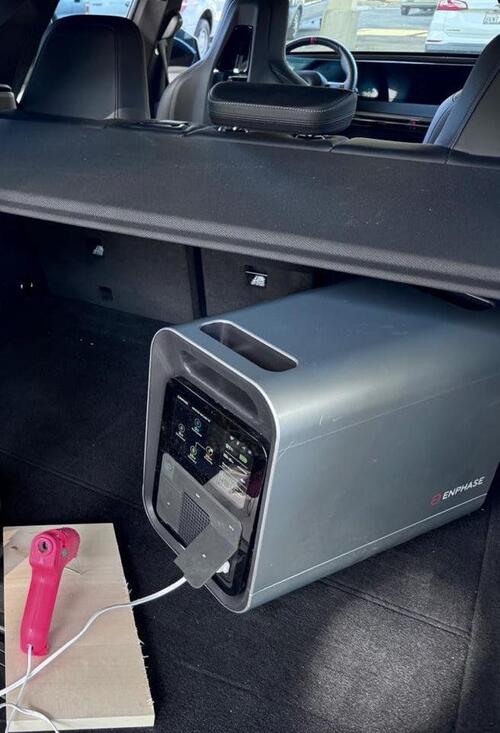
The port lineup is practical: 4 AC outlets, 4 USB-A ports, 2 USB-C ports, and 1 DC 12V output. That covers the usual outage mix — fridge, router, laptop, phone, lights, and small DC gear.
The one annoying gap is USB-C detail. The product data does not list USB-C PD wattage, so laptop users should confirm whether those USB-C ports can handle their exact machine or plan to use the AC adapter instead.
In practice, owners seem happy with the layout. The covered ports and separated input/output sides help with cable routing, which matters when the unit is wedged behind a fridge or packed beside camp gear.
Quiet Backup Still Needs Ventilation
The Enphase 1500Wh LiFePO4 power station gets strong feedback for quiet use.
That said, no customer feedback here gives exact fan levels. Fast AC charging and heavy inverter loads may still make fan noise, so bedroom users should test it before relying on it beside a bed.
Pro Tip — For outage prep, test the unit with your refrigerator, router, and any medical equipment before the storm hits. You’ll learn the real runtime, fan behavior, and cord layout while the stakes are low.
Heat concerns do not show up as a customer theme in the provided feedback. The safety story is helped by LFP chemistry, UL testing, and a listed operating range from -4°F to 122°F, but you still shouldn’t leave it cooking in a sealed hot car for days.
Touchscreen, Wi-Fi, Bluetooth, and LTE as a Control Stack
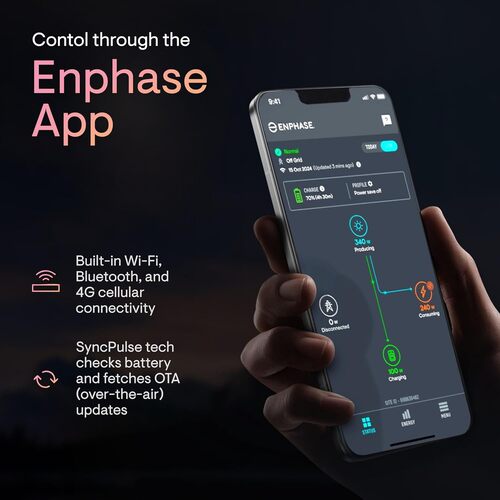
The 7-inch color LCD touchscreen gets positive comments. Owners describe the screen as clear and vivid, with enough information to track charge level and remaining time without guessing.
The app is a real advantage for Enphase households. Several users like monitoring battery level, power usage, and outage behavior through the Enphase or Enlighten app, especially when the unit is supporting a refrigerator or internet setup away from where they’re standing.
Worth knowing, one owner wished the app had notified them more clearly when the unit switched to battery mode. That’s not a deal-breaker, but it’s exactly the kind of detail to test during setup rather than during a real blackout.
Certifications and Warranty Are Part of the Premium
The IQ PowerPack 1500 uses LiFePO4 battery chemistry. That’s a good fit for a backup battery because LFP tends to favor long cycle life and thermal stability over being the lightest possible chemistry.
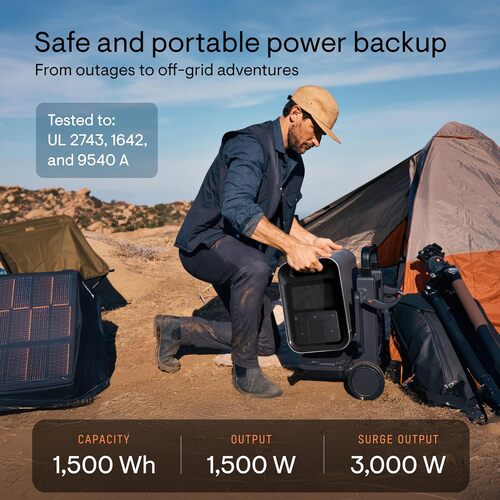
Enphase also leans hard into safety here. The product lists UL 9540A thermal runaway safety testing and UL 2743 outdoor-use certification, plus a 5-year or 2,500-cycle limited warranty.
Long-Term Ownership — A 2,500-cycle rating means years of typical backup and camping use before cycle wear becomes the main concern. Daily full cycling will age any battery faster, but LFP is the right chemistry for frequent use.
The customer feedback is mostly reassuring, but support is not perfect. One buyer reported a dead-on-arrival unit and frustration with replacement handling, while other complaints focus more broadly on Enphase installer and support experiences.
Best Practice — Store the battery around 50-80% charge when it won’t be used for a while, and top it off every few months. LiFePO4 is durable, but long storage at 0% or 100% is still rough on battery health.
For most buyers, the safety package is a major reason to choose this over cheaper alternatives. To be fair, that only matters if the product and support experience live up to the price.
Who Benefits From the Enphase Integration Premium
| Use Case | Fit | Why |
|---|---|---|
| Weekend car camping | Strong fit | Good capacity, quiet output, and plenty of ports for camp electronics |
| RV side-trip / van life | Strong fit | Owners report using it well while boondocking and powering RV needs |
| Home blackouts under 8 hours | Strong fit | Great for fridge, router, lights, laptop, and key appliance support |
| Multi-day off-grid cabin | With caveats | Useful with solar, but max solar input and expandability are not clearly specified |
| CPAP overnight backup | Strong fit | 1,500Wh capacity gives comfortable overnight margin for many CPAP setups |
| Refrigerator backup | Strong fit | Customers report good fridge support and useful runtime estimates |
| Jobsite power tools | Borderline | 1,500W output works for some tools, but surge headroom is limited in the specs |
| Quiet bedroom UPS | Solid fit | Sub-10ms switch is promising, but test fan noise and exact device behavior first |
| Hurricane / multi-day outage | With caveats | Strong for essentials, but not a whole-home or expandable battery system |
| Tailgating / outdoor events | Solid fit | Good ports and capacity, though 45.9 lb makes the cart appealing |
| Backpacking / lightweight EDC | Skip | Too heavy for anything foot-carried |
| Apartment without solar access | Strong fit | Fast AC recharge makes it useful even without panel access |
You’ll probably be happy with it when you need quiet refrigerator backup without gas fumes, a portable battery for RV trips, overlanding, or car camping, a power station that fits naturally into an Enphase household, fast AC recharge for outage prep, and indoor-friendly LFP chemistry and safety certifications.
You might want to skip it when you need whole-home backup power, a lightweight battery under 25 lb, published third-party solar specs before purchase, a high-surge unit for pumps, large tools, or big compressors, or the cheapest 1,500Wh battery available.
Different tool, different job. The IQ PowerPack 1500 is best as a quiet essentials battery, not a replacement for a permanently installed home battery system.
Pros & Cons Analysis
Based on documented specifications and owner feedback
Pros
- Exceptionally explicit documentation — Rated and usable capacity, surge duration, PV limits, transfer time, cycle rating, certifications, and warranty are all available for the exact product.
- Rich local and remote controls — The touchscreen remains useful on site while Wi-Fi, Bluetooth, and LTE provide multiple connectivity paths.
- Credible continuity specification — The published under-10ms transfer supports office and essential-load planning after the exact equipment passes a drill.
- Safety evidence is part of the product — UL listings and a defined warranty reduce ambiguity for buyers who prioritize documented compliance over maximum headline output.
- Strong fit for measured moderate loads — A 1,500Wh usable pack can provide meaningful refrigerator, communications, office, and electronics runtime when the inverter ceiling is respected.
Cons
- Output is the central compromise — Many competing 1–2kWh stations publish 1,800–2,400W continuous output, while this unit stops at 1,500VA.
- Premium value is audience-specific — Buyers outside the Enphase ecosystem may find more inverter power or solar input per dollar elsewhere.
- The enclosure is substantial — At 45.9 pounds, regular room-to-room or campsite movement is easier with the cart and a clear route.
- Solar flexibility is bounded — The 60V absolute maximum and 10A input ceiling can reject common series or parallel arrangements unless they are calculated carefully.
- Account and support friction can matter — Owner setup and remedy accounts make enrollment, firmware, purchase records, and arrival testing part of the commissioning process.
Our Verdict
This Enphase IQ PowerPack 1500 review comes down to trust, safety, and everyday usefulness. It's not the lightest power station in this class, and the missing published solar input wattage is frustrating. Still, owners consistently describe it as easy to set up, fast to recharge, quiet indoors, and genuinely helpful when the power goes out.
Go with the Enphase IQ PowerPack 1500 portable power station when your priority is clean backup power for fridges, routers, laptops, RV loads, and emergency essentials. Skip it when you need whole-home coverage, big surge capacity, or a featherweight camping battery. For the right buyer, it's a practical, safety-focused backup box that earns its spot before the next outage.
Frequently Asked Questions
How long will the Enphase IQ PowerPack 1500 run a refrigerator?
Runtime depends on the refrigerator size, compressor cycling, room temperature, and startup surge. Customer feedback suggests it can keep a typical refrigerator running for many hours, and one owner saw an estimate close to 40 hours under light cycling conditions. A safer real-world expectation is roughly 8 to 20 hours for many full-size fridges.
Can the Enphase IQ PowerPack 1500 run a kettle or microwave?
It can handle some high-draw appliances briefly as long as they stay within the 1,500W output limit. One owner reported boiling a 1,350W electric kettle multiple times. A 1,500W kettle sits right at the ceiling, and larger microwaves, hair dryers, or heaters may overload it.
How fast does the Enphase IQ PowerPack 1500 recharge from AC?
The provided product data claims a full AC recharge in under 75 minutes. Several owners also describe very fast wall charging, with some saying it reached full in about an hour.
How long does solar charging take?
The product data claims roughly 4 hours with solar panels, though exact maximum solar input wattage is not listed. One owner using two panels saw a quick initial charge on a partly cloudy day, while another noted that solar charging works best with plenty of space and a clear view of the sun.
Does the Enphase IQ PowerPack 1500 work as a UPS?
The product claims grid-to-backup switching in under 10ms, and owners report using it for routers, refrigerators, laptops, monitors, and key appliances during short outages. For medical equipment or work computers, test your exact setup before relying on it during a real outage.
Is the Enphase IQ PowerPack 1500 quiet enough for indoor use?
Customer feedback is positive on noise. One owner specifically described it as quiet and appreciated not having to start a gas generator outdoors in the cold. Fan noise may still become more noticeable during heavy loads or fast charging.
What battery chemistry does it use?
It uses LiFePO4, also called LFP or lithium iron phosphate. That chemistry is generally favored for long cycle life, better thermal stability, and frequent backup use compared with older NCM lithium-ion designs.
Is it easy to carry?
At 45.9 lb, it is portable but not light. Owners like the handle design and smooth shell, and some mention the optional cart as a useful add-on for moving it around the house or campsite.
Does the app work well?
Owners generally like being able to monitor load, battery level, and charge status through the Enphase or Enlighten app. One user wished the app sent a clearer alert when battery mode activated, so notification behavior is worth checking during setup.
Can it work with an existing Enphase solar system?
Yes, the product is designed to work natively with the Enphase ecosystem, and several owners with Enphase rooftop solar systems liked that connection. It can also be used as a standalone portable power station.
What are the biggest drawbacks?
The main trade-offs are weight, premium pricing, unclear published solar input wattage, limited surge headroom in the provided specs, and a few customer support complaints. One buyer also reported a dead-on-arrival unit and frustration with the replacement process.
Technical Specifications
| Brand | Enphase Energy |
|---|---|
| Model / SKU | IQ PowerPack 1500 / PES-1515-BL-US (ASIN: B0DVZ8ML4J) |
| Battery capacity | 1,500 Wh |
| Battery chemistry | LiFePO4 (LFP) |
| Cycle-life rating | 2,500 cycles |
| Expandable capacity | Not published for this exact model in the current source set |
| Continuous AC output | 1,500 W continuous (clean AC output via built-in IQ8 microinverters) |
| Surge / peak output | 1,500 W listed starting wattage |
| AC voltage, frequency, and waveform | 120V AC, waveform not published; frequency not published for this exact model |
| AC outlets | 4 × 120V AC outlets |
| High-current, RV, or 240V output | No dedicated RV, 30A, 240V, or other high-current AC outlet published for this exact model |
| USB-C outputs | 2 × USB-C (wattage not specified) |
| USB-A outputs | 4 × USB-A (wattage not specified) |
| 12V / DC outputs | 1 × DC 12V output |
| Maximum solar input | Not published for this exact model in the current source set |
| Solar input range and connector | Not published for this exact model in the current source set; exact PV voltage/current window and connector are unavailable |
| Maximum AC input | Not published for this exact model in the current source set; the prior value was an editorial estimate, not an exact-model rating |
| AC recharge time | Under 75 minutes |
| Solar recharge estimate | Planning estimate: roughly 4 hours |
| UPS / EPS support and transfer time | Yes — under 10ms grid-to-backup switch |
| App / connectivity | Yes — Enphase app / Enlighten app via 4G cellular, Wi-Fi, and Bluetooth |
| Operating temperature / weather rating | -4–122°F (-20–50°C); UL 2743 outdoor-use certification |
| Dimensions | 16.5 × 9.3 × 13.6 inches |
| Weight | 45.9 lb |
| Warranty | 5 years or 2,500 cycles, whichever occurs first |