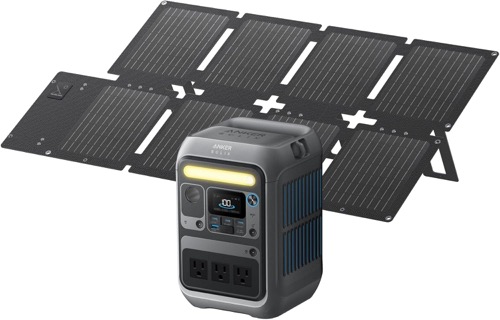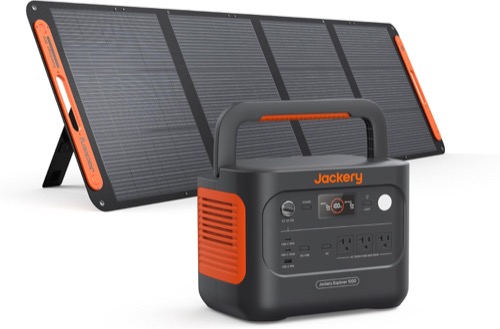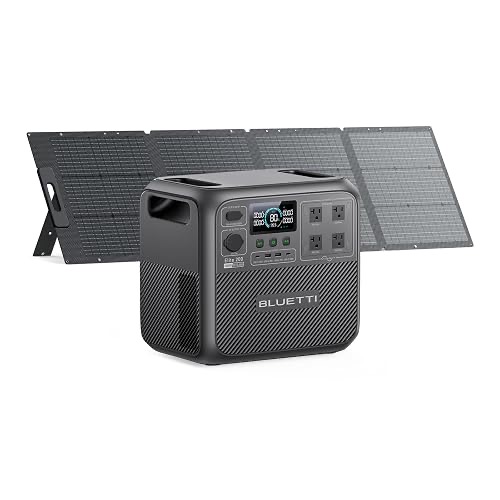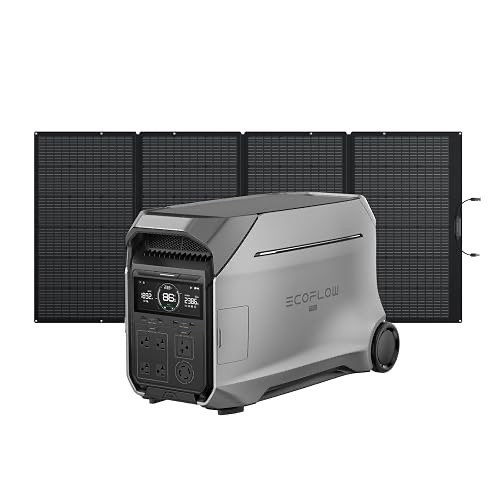
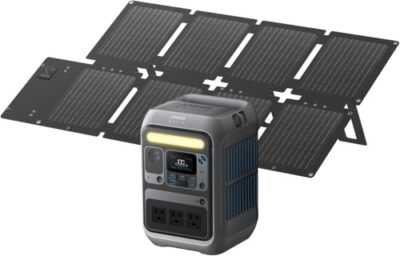
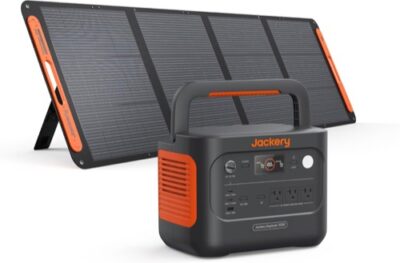
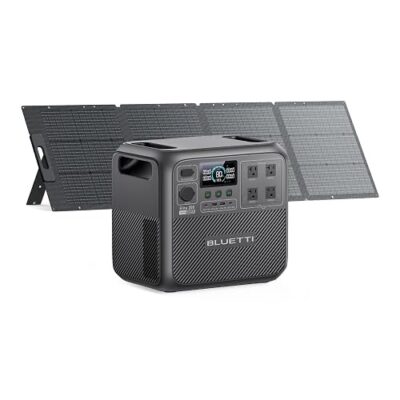
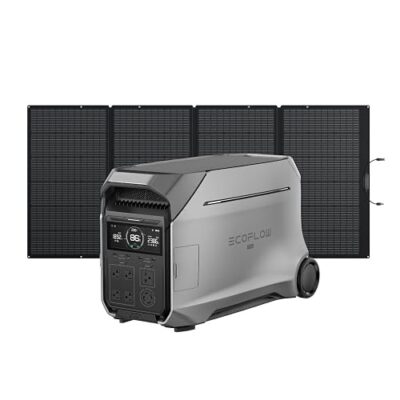
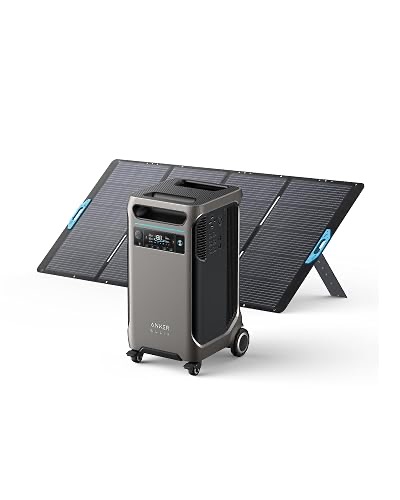
There is no single best solar generator size. The useful market runs from a 288Wh personal-power kit to multi-kilowatt-hour 120/240V platforms, and each step changes the loads, carry burden, solar footprint, and installation questions. These five exact bundles form a capacity ladder so you can stop at the first rung that passes every requirement.
Climb the Capacity Ladder One Requirement at a Time
| Rung | Exact kit | Typical role |
|---|---|---|
| 288Wh / 300W | Anker C300 + 60W | Travel electronics and selected low-power devices |
| 1,070Wh / 1,500W | Jackery 1000 v2 + 200W | Weekend trips and controlled appliance use |
| 2,073.6Wh / 2,600W | BLUETTI Elite 200 V2 + 200W | Longer fixed 120V reserve |
| 4,096Wh / 4,000W | EcoFlow DELTA Pro 3 + 400W | Native 120/240V home or RV planning |
| 3,840Wh / 6,000W | Anker F3800 + 400W | High-output 120/240V and expandable systems |
Do not move up a rung merely because the next inverter number is larger. Advance only when load compatibility, energy duration, recovery, voltage, or expansion requirements cannot be met below it.
Pass the Load Gate Before Estimating Runtime
List simultaneous running watts and the largest startup event. C300 is a 300W station; its energy capacity is irrelevant when a load exceeds that boundary. The larger platforms can start more appliances, yet a 4,000W load can still consume a 4kWh battery in roughly an hour before losses. Output answers “can it run?” while watt-hours answer “for how long?”
Find the Included-Array Bottleneck
Jackery 1000 v2 includes 200W against a 400W receiver. C300’s 60W panel is close to its small 100W solar ceiling. Elite 200 V2 includes 200W against a 1,000W receiver. DELTA Pro 3 and F3800 each include one 400W panel despite much larger storage and receiver potential. A bundle can be electrically valid while still under-paneled for daily off-grid recovery.
Separate Portable Power From Home-System Capability
C300 and Jackery 1000 v2 are straightforward portable systems. Elite 200 V2 is a heavier fixed-capacity 120V station despite remaining movable. DELTA Pro 3 and F3800 enter 120/240V platform territory where outlets, transfer equipment, expansion, placement, and qualified installation may matter more than the carry handle.
Compare the Two Large Platforms by Architecture
Neither one-panel bundle should be interpreted as a complete off-grid home array. Price the solar expansion, cables, batteries, and transfer hardware required by the intended use.
Keep Product Evidence in the Correct Lane
Manufacturer documentation establishes exact limits and compatibility. Owner reports reveal setup patterns, recurring complaints, and service scenarios, but a selected review sample cannot calculate population failure rates. This site has not lab-tested these kits. Treat every conclusion as an evidence-based buying decision that still requires acceptance testing of the delivered unit.
Run a Five-Gate Final-Fit Scorecard
- Load: running and startup demand fit with reserve.
- Energy: usable Wh cover the planned duration.
- Recovery: the actual array and other chargers close the energy loop.
- System: voltage, outlets, connectors, transfer behavior, and expansion match.
- Ownership: weight, storage, warranty, support, and return testing are acceptable.
Use the Return Window as a Commissioning Window
Inspect serials, panels, stands, cables, and ports; update firmware where appropriate; then test the actual load and each charging route. Simulate the conditions that matter—overnight cycling, vehicle charging, panel deployment, or loss and restoration. Keep packaging until the system completes its intended job.
Price the Ownership Path Beyond the Starter Bundle
Add the components required by the intended role: compatible panels, extension leads, adapters, expansion batteries, transfer hardware, mounts, weather protection, and qualified labor. Also price the storage space and movement equipment needed for the complete system. A cheaper station can become the expensive choice when it immediately requires a second array, another battery, or replacement cables to complete the job.
Keep day-one and future costs in separate columns. The day-one total should complete the stated mission without relying on an accessory that may never be purchased. The future column can include expansion batteries, higher-power arrays, transfer equipment, and mobility aids, together with the compatibility evidence needed for each addition. This prevents an attractive starter price from hiding the real cost of reaching the intended system class.
Stop at the Smallest Correct Rung
Choose C300 for a small carried kit, Jackery 1000 v2 for balanced 1kWh use, Elite 200 V2 for compact fixed 2kWh reserve, DELTA Pro 3 for a 4kWh 120/240V platform, or F3800 for the highest output and expansion range.